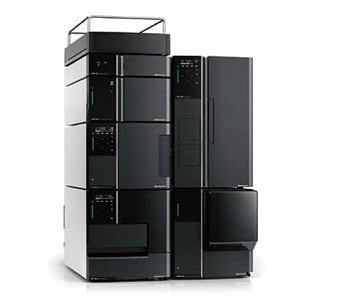
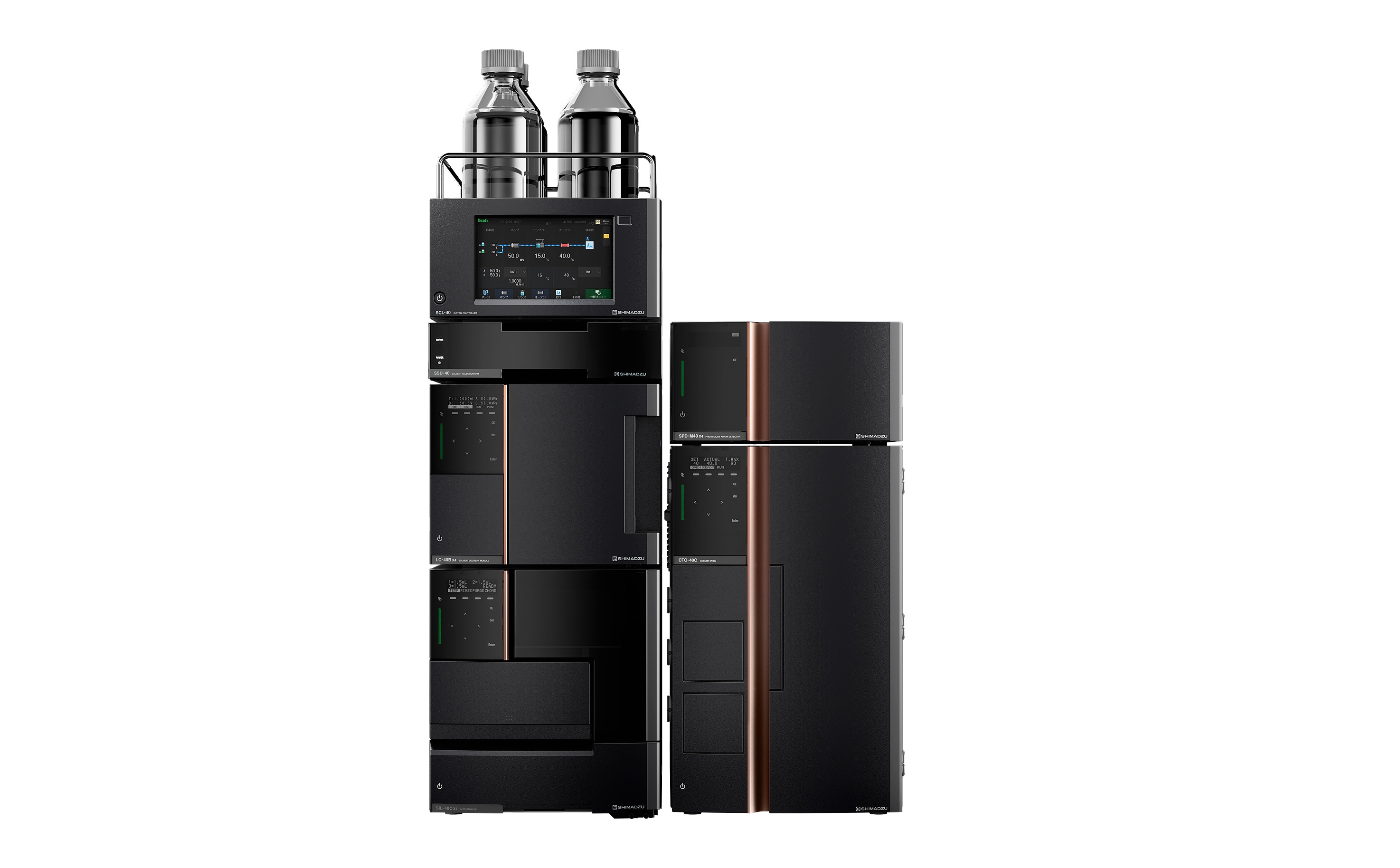
Nexera X4 Ultra High-Performance Liquid Chromatograph


- Owing to the excellent delivery performance of Nexera X4, high retention-time reproducibility can be achieved even under long, shallow gradient conditions. - Mass information obtained using a single quadrupole mass spectrometer can be utilized as qualitative data for each peptide fragment, thereby improving the reliability of the results.
Peptide mapping is important for confirming the primary structure of proteins and for evaluating the consistency of their quality. In analyses using LC (reversed-phase chromatography), a large number of peptide fragments generated by digestion are separated using a solvent delivery approach in which the proportion of organic solvent in the mobile phase is gradually increased over an extended period through a shallow gradient. This gradual change in organic solvent enables the separation of peptides with similar hydrophobicity, but the performance of the solvent delivery pump, which precisely controls the organic solvent ratio, is critically important for achieving retention-time reproducibility. Nexera X4 inherits technologies developed in Shimadzu’s Nexera series and is a next-generation ultra-high-performance liquid chromatography (UHPLC) system that achieves top-class analytical performance. Its solvent delivery pump features independently actuated plungers and a pressure feedback mechanism, enabling precise solvent delivery and excellent reproducibility even under long, shallow gradient conditions. In this article, an example is presented in which Nexera X4 was used to analyze tryptic digests of BSA. Furthermore, by combining the system with a single quadrupole mass spectrometer, the acquisition of mass information as qualitative data for each peptide fragment is also demonstrated.
March 2, 2026 GMT
Some products may be updated to newer models