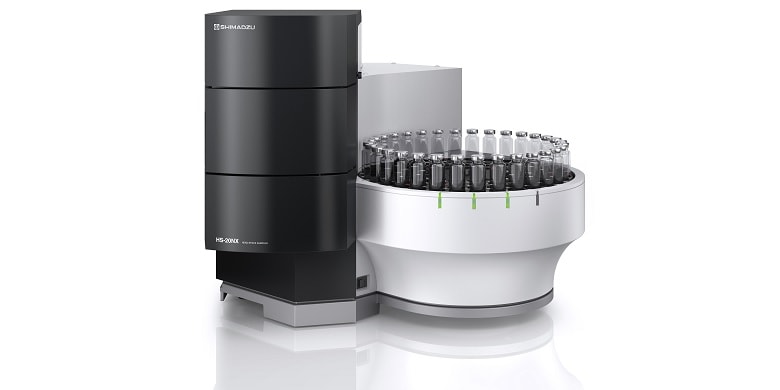
HS-20 NX series


- Shimadzu GCMS-TQ8050 NX with HS-20 NX autosampler works with LabSolutions GCMS 21CFR compliant software which extends its utilization in compliance environment like pharmaceuticals - Trap headspace enables concentrating the analytes in cold trap with multi-injection count and helps to achieve higher sensitivity over static headspace, especially for trace level quantitation
Overview: Alkyl and aryl sulfonic acids have been used in the synthesis of active pharmaceutical ingredients (APIs) in various measures. They are known for their acid catalytic properties, sulfonamide intermediates and as agents to enhance solubility through salt formation. However, as the reactions progress, they form their respective esters, which are well-known potent genotoxic impurities (GTIs), that act as DNA-alkylating agents in biological systems posing mutagenic and carcinogenic risks even at trace levels. Hence, it is necessary to categorize, qualify, and control these impurities to limit the potential carcinogenic risks, as mentioned in ICH M7(R2). Nintedanib Esylate API belongs to a family of kinase inhibitors, used primarily to treat idiopathic pulmonary fibrosis (IPF). It acts as a triple angiokinase inhibitor which targets receptors involved in pulmonary fibrosis. The synthesis of the API often involves the reaction of Nintedanib free base with Ethane Sulfonic Acid in a process called as salification. The salt formed in the form of yellow crystals is used further in formulations to enhance stability as well as solubility. The by-product of this reaction, often due to presence of residual short-chain alcohols, is Methyl Ethane Sulfonate (MES). As per the ICH M7(R2) guidelines, a TTC (Threshold of Toxicological Concern) based acceptable intake of a mutagenic impurity of 1.5 μg/day which can be used for most pharmaceuticals as a default value, to derive an acceptable limit for control. Nintedanib Esylate is supposed to be administered orally. Strength of the Nintedanib Esylate API in most of the medicines is 150 mg per capsule and prescribed dose is twice in a day. Irrespective of the limit calculated from maximum daily dose, Shimadzu has worked upon developing a method for quantification of MES at lowest possible detection so that it will be beneficial for the concern pharmaceuticals even if daily dose exceeds 0.3 g/day.
September 10, 2026 GMT