MALDI-8030


- Confirmation of live probiotic bacteria from commercial skincare products. - Minimal sample preparation, rapid and cost-effective operation to ensure formulation safety. - Large database of in silico predicted marker masses ensures precise, reliable bacterial identifications even for samples which may not have previously been analysed by MALDI-TOF MS.
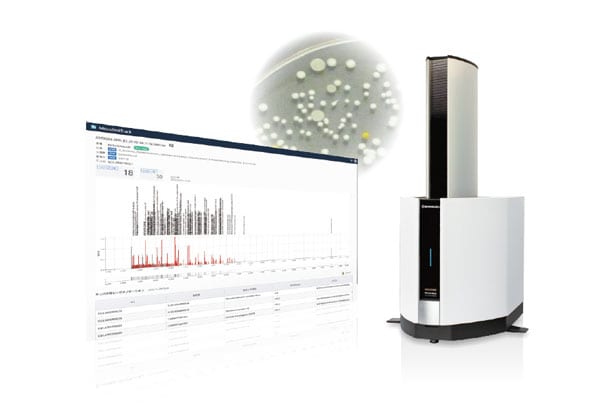
In recent years, matrix-assisted laser desorption/ionisation time-of-flight mass spectrometry (MALDI-TOF MS) has become the method of choice for routine identification of bacteria and fungi in microbiology laboratories. It involves the detection of a microorganism's unique ribosomal proteins as these are highly conserved and rarely post-translationally modified. The microorganism's detected protein signature is then compared against a database of in silico predicted marker masses based on whole genome data. Compared to classical microbiological methods, microbial identification by MALDI-TOF MS has several advantages such as rapid, simple and cost-effective operation. It is widely used in various fields of food, environmental and clinical microbiology. Here, we describe an application of MALDI-TOF MS to identify probiotics in skincare products. In recent years, topical probiotic products have become more widely available and marketed as treatments for a variety of skin conditions e.g. atopic dermatitis where the normal skin barrier function is compromised. Among the multiple bacterial strains that have been investigated for their anti-inflammatory, antimicrobial and restoration of the skin barrier function properties, Lactobacillus reuteri DSM 17938 is one of the most studied and has been used in numerous human clinical trials for its safety and effectiveness. MALDI-TOF MS can be useful in the context of skincare quality control for: i) contaminant detection, and ii) product viability and label verification, to ensure the microorganisms stated on the product label are actually present and alive. It is worth noting that L. reuteri DSM 17938 goes by the scientific name of Limosilactobacillus reuteri subsp. kinnaridis. Within the scope of microbial identification, MALDI-TOF MS is generally considered most reliable for identification at the species level and subspecies-level assignment is not typically expected. Bacteria are first grown on suitable media. In the simplest case, material from a single colony is directly smeared onto a Shimadzu FlexiMass-DS target followed by deposition of a droplet of MALDI matrix (CHCA). In some cases, a formic acid extraction may be necessary, particularly for Gram-positive bacteria which have thicker cell walls. Bacterial protein profiles are acquired on a Shimadzu MALDI-8000 EasyCare series MALDI-TOF mass spectrometer. Spectra are searched and identified with the MicrobialTrack software (Shimadzu).
November 4, 2026 GMT
Some products may be updated to newer models