MALDI-8030


- Rapid confirmation of live probiotic cultures from commercial food products. - Early detection of bacterial contaminants to support food quality and brand protection. - Large database of in silico predicted marker masses ensures precise, reliable bacterial identifications even for samples which may not have previously been analysed by MALDI-TOF MS.
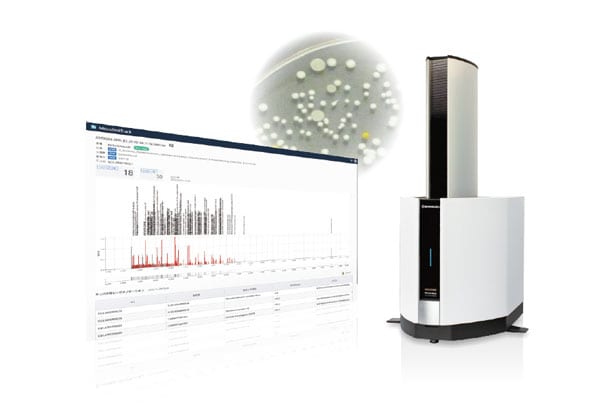
In recent years, matrix-assisted laser desorption/ionisation time-of-flight mass spectrometry (MALDI-TOF MS) has become the method of choice for routine identification of bacteria and fungi in microbiology laboratories. It involves the detection of a microorganism's unique ribosomal proteins as these are highly conserved and rarely post-translationally modified. The microorganism's detected protein signature is then compared against a database of in silico predicted marker masses based on whole genome data. Compared to classical microbiological methods, microbial identification by MALDI-TOF MS has several advantages such as rapid, simple and cost-effective operation. It is widely used in various fields of food, environmental and clinical microbiology. Here, we describe an application of MALDI-TOF MS to identify probiotics in commercial yoghurt products. Probiotics are defined as "live microorganisms which, when administered in adequate amounts, confer a health benefit on the host". MALDI-TOF MS can be useful in the context of food quality control e.g.: i) contaminant detection i.e., to detect the presence of unwanted, spoilage or pathogenic bacteria, and ii) product viability and label verification, to ensure the microorganisms stated on the product label are actually present and alive. Bacteria are first grown on suitable media. In the simplest case, material from a single colony is directly smeared onto a Shimadzu FlexiMass-DS target followed by deposition of a droplet of MALDI matrix (CHCA). In some cases, a formic acid extraction may be necessary, particularly for Gram-positive bacteria which have thicker cell walls. Bacterial protein profiles are acquired on a Shimadzu MALDI-8000 EasyCare series MALDI-TOF mass spectrometer. Spectra are searched and identified with the MicrobialTrack software (Shimadzu).
November 9, 2026 GMT
Some products may be updated to newer models