


Minds Behind the HPV Series
This article contains a transcript of an interview with the engineers who developed Shimadzu’s high-speed video camera.
It demonstrates their passion for development and their future vision for high-speed video cameras.
High-Speed Video Cameras in 2050
High-speed video cameras are state-of-the-art cameras that can accurately and comprehensively capture momentary events that occur faster than the human eye can perceive. In the future, high-speed video cameras will be sought by more users in an even broader range of applications.
What will high-speed video cameras be like 25 years from now? In the following interview, Professor Sugawa and Professor Kuroda of Tohoku University, who developed the underlying technology for Shimadzu’s high-speed video cameras, and Shimadzu’s product development engineer sat down to discuss their passion and vision for the future development of high-speed video cameras.
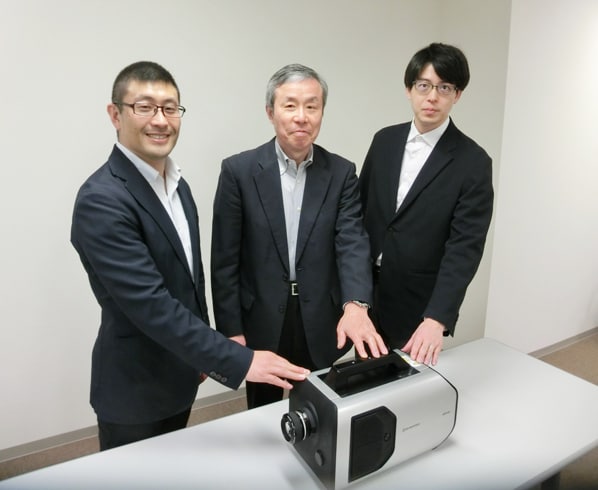
Professor Rihito Kuroda (left), Professor Shigetoshi Sugawa (center), and Assistant Professor Takezo Mawaki of Tohoku University’s New Industry Creation Hatchery Center
Note: The above-listed positions and affiliations were current at the time of publication.
AI Cameras

Professor Sugawa:
We used the latest semiconductor technology to mount the sensor and the multiple memories corresponding to each pixel on the same chip, thereby increasing the speed of the video camera.
Given the dizzying advances in semiconductor technology, in 10 years it may be possible to mount not only the current memory but also data processing equipment such as AD converters, large-scale DRAM, and even AI on the same semiconductor chip.
Considering this situation, it is important to consider what cameras will be like 25 years from now.
Kitamura (product development engineer at Shimadzu Corporation):
I think that the fate of high-speed video cameras lies in answering the crucial question of how to efficiently analyze the huge amount of information accumulated by the enormous time resolution.
Even a single second is equivalent to 20 million frames based on the 50 nanosecond time resolution of a high-speed video camera. If we played all of these frames back at 30 fps, it would take a week to see them all. That would truly require an immense amount of effort akin to searching the ocean for specific grains of sand, and there are limits to human capacity.
In these situations, we may need to enlist the help of AI to detect events and to understand the accompanying phenomena.
User-Friendly Cameras
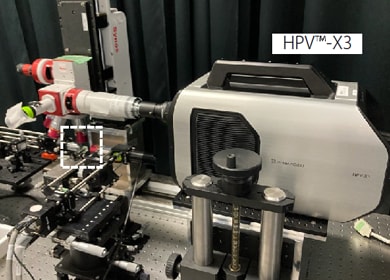
Example of high-speed video camera recording.
Various recording methods must be devised to accommodate the event being recorded.
(Photo provided courtesy of Associate Professor Kyoko Namura, Micro Process Engineering Laboratory, Department of Micro Engineering, Graduate School of Engineering, Kyoto University)
Professor Kuroda:
The semiconductor technology used in cameras should certainly advance if only by catching up with the latest technology given that there are plenty of players in the industry. I think that the basic performance of cameras, such as the sensor speed, number of memories, and pixel count, can be gradually improved by using the latest semiconductor technology.
Also of significant importance is the development of peripheral technologies required for high-speed cameras. Specifically, a device that can only be used by certain people is undesirable. Enhanced user friendliness and post-processing functions, miniaturization, and light source refinements are all needed to make the camera easy to operate.
After all, it is people who use the camera, so it is crucial to understand not only its performance but also how the operator uses the camera and what type of front-end and back-end processes are involved in the overall process. That is why it is important to develop the camera as a total solution that is as user-friendly as possible.
It is therefore essential to understand how the camera is used and to make steady progress while working with the users.
Cameras at the Forefront of Technology
Kitamura:
Since you mentioned AI, one of the biggest shortcomings of our camera is the recording capacity, which is currently limited to 256 frames.
If the volume of information recorded in the memory can be reduced by integrating AI, the current recording capacity of 256 frames might be sufficient.
Professor Sugawa:
Certainly, the current limit of 256 frames may be a shortcoming. However, I believe that this limitation can surely be overcome through technological development.
That is why it is better to avoid the contrivance of reducing the amount of information in advance.
Superficial technologies will only serve as a stopgap measure and will not last long.
High-speed video cameras are devices that allow humans to see what we cannot see, and it is very difficult to predict what we cannot see.
The real charm of this device is that it enables unexpected discoveries provided that you don’t stop searching even when there is an immense amount of image data to sift through.
Professor Kuroda:
I think that one of the virtues of this device is that it has been developed by leveraging the current established body of science and technology.
I believe that good things will come if you continue along this path and do not seek shortcuts.
Cameras Beyond Our Expectations
Professor Sugawa:
While our entire discussion of cameras thus far has essentially been about cameras in the future, we are talking about cameras in the near future, such as 10 years from now, rather than 25 years from now.
This concerns technology that we can already see, whereas we are probably incapable of imagining what technology will be like in 25 years, and we must recognize that.
That is why it is important to incorporate the latest technologies to make better cameras while constantly imagining the future.
It is crucial to continue development in the belief that a better future lies beyond the diligent efforts and general principles that we have adhered to thus far, and to betray our expectations in the positive sense of the term.
Conclusion
In this interview we discussed ideas for future high-speed video cameras with professors involved in this technology.
We concluded that to develop products that will surpass our expectations in a positive way, it is important to continue making steady progress by applying the latest semiconductor technologies, which will advance the hardware, and by implementing software changes to make more user-friendly products and total solutions.
To continue making the world’s most advanced high-speed video cameras, Shimadzu will continue to pursue the creation of new value by leveraging innovative technologies such as AI and semiconductor technology.
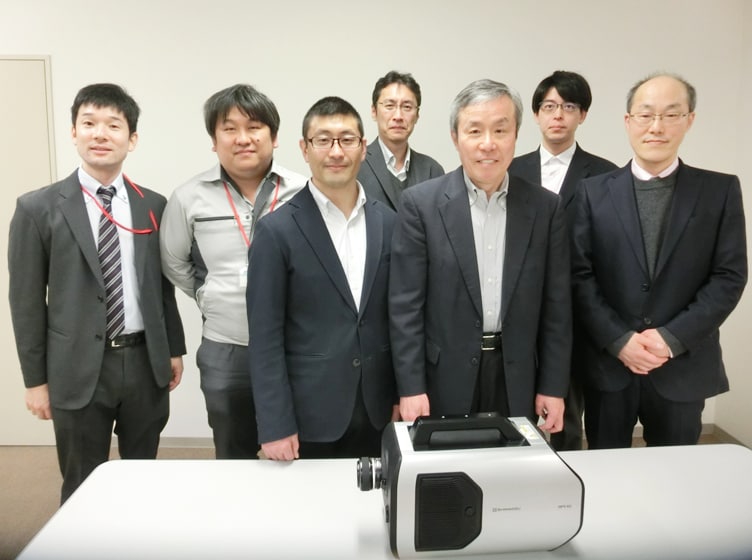
Professor Sugawa, Professor Kuroda, Assistant Professor Mawaki, and Shimadzu’s Product Development Team Member with the New HyperVision HPV-X3