


Solutions for Nitrosamine Analysis -common nitrosamines, NDSRIs using LC-MS/MS, GC-MS/MS and LC-HRMS-
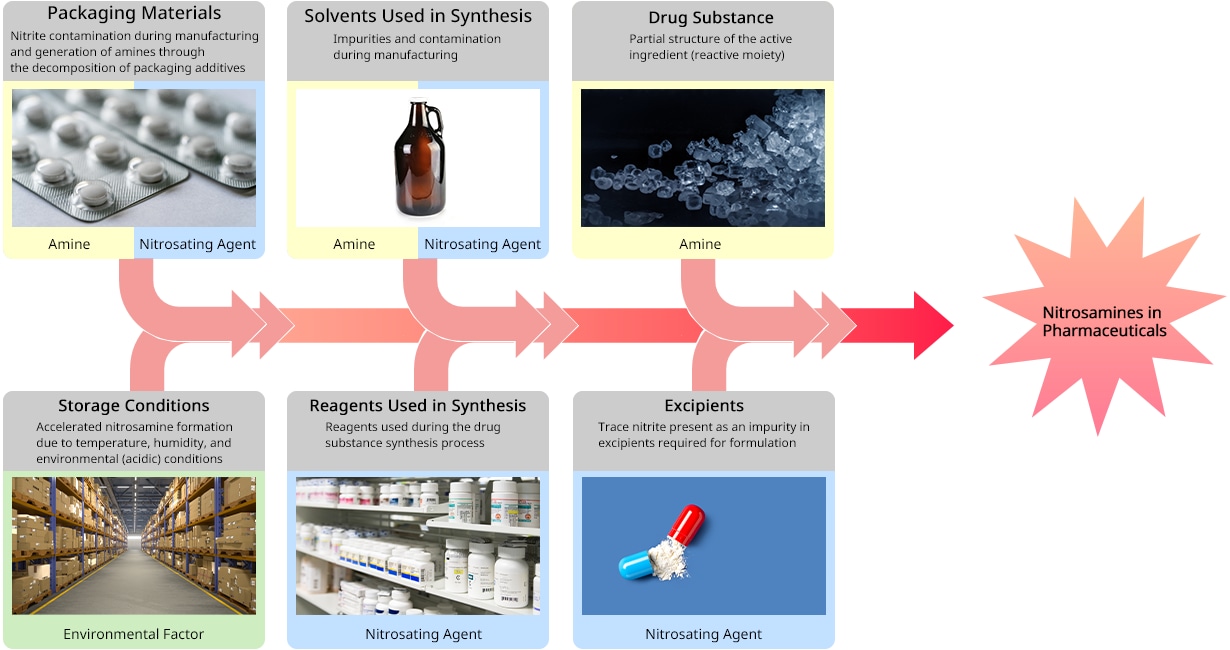
Sources of Nitrosamine Contamination
Nitrosamines are a group of compounds that form when the hydrogen of an amine nitrogen is replaced by a nitroso group. They are a concern due to their potential carcinogenicity.
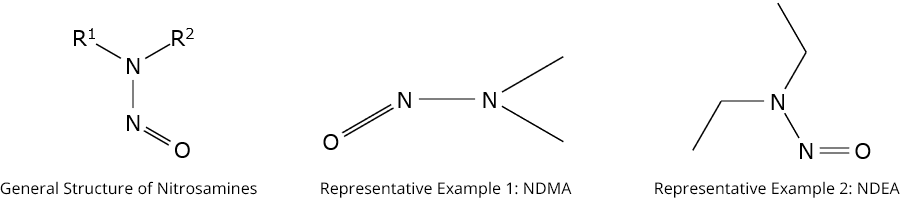
Nitrosamine drug substance-related impurities (NDSRIs) are a group of compounds formed when secondary or tertiary amines within a drug substance undergo nitrosation. Active Pharmaceutical Ingredients (APIs) containing secondary or tertiary amines within their molecular structure have been found to react with nitrosating agents, resulting in the formation of NDSRIs. Recently, NTTP, an NDSRI, was detected in generic medicines containing sitagliptin.
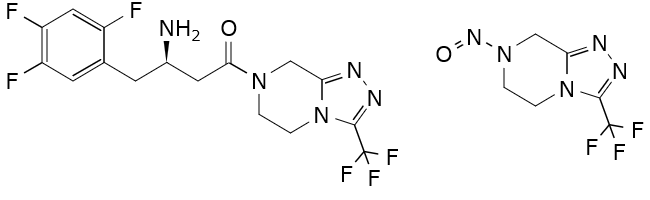
Structures of Sitagliptin(left) and NTTP (right)
Nitrosamines are known to form through the reaction of amines with nitrites. Reports have shown that nitrites from various sources may pose a risk of nitrosamine formation, including those added to quench azide compounds used in synthetic routes, such as tetrazole ring formation, as well as those present as impurities in reagents and excipients.

Typical Reaction to Form NDMA (Reference: FDA Control of Nitrosamine Impurities in Human Drugs)
In July 2018, N-nitrosodimethylamine (NDMA) and N-nitrosodiethylamine (NDEA) were detected in the active pharmaceutical ingredient of valsartan, an angiotensin II receptor blocker. Since then, various nitrosamines have been detected in multiple medications, leading to shipment suspensions and voluntary recalls, which has become a significant global issue. In response, regulatory authorities such as the FDA and EMA have issued guidance on the control of nitrosamines in pharmaceuticals, requiring manufacturers to conduct risk assessments and implement risk mitigation measures.
The deadline for implementing risk mitigation measures under these notifications expired on August 1, 2025. However, review, risk assessment, consideration of risk mitigation measures, and regulatory procedures will continue to be required for a broad range of drug products—including chemically synthesized drugs, biological products, drug products in which nitrosamines have not previously been detected, and products confirmed to contain nitrosamines within acceptable limits—whenever any of the following conditions apply:
- When applying for approval of a new drug
- When making changes that may affect nitrosamine contamination, such as changes to the manufacturing process, formulation, or primary packaging
- When new scientific information on nitrosamines becomes available
- FDA guidance:https://www.fda.gov/media/141720/download (Refor to FDA)
- EMA guidance:https://www.ema.europa.eu/en/human-regulatory-overview/post-authorisation/pharmacovigilance-post-authorisation/referral-procedures-human-medicines/nitrosamine-impurities (Refer to EMA)
The sources of nitrosamine contamination are wide-ranging. They include formation during synthesis, contamination from reagents and solvents, carryover from shared equipment, migration from packaging materials, and generation during storage. Therefore, investigations should be conducted not only by marketing authorization holders but also in collaboration with manufacturers and suppliers of packaging containers and related materials.
The analysis of nitrites, which are a key contributor in nitrosamine formation, is addressed in guidance documents from the FDA and EMA. Nitrite and nitrate in pharmaceutical raw materials can be determined using ion chromatography. Application examples are presented below.
Analysis of Small-Molecule Nitrosamines
For the analysis of these nitrosamines, highly sensitive and selective methods such as LC-MS/MS, GC-MS/MS, and LC-HRMS are widely used. USP General Chapter <1469> includes methods for analyzing nitrosamines in pharmaceuticals using LC-MS/MS and GC-MS/MS. EP General Chapter 2.5.42 includes methods for analyzing nitrosamines in pharmaceuticals using GC-MS, LC-MS/MS, and GC-MS/MS.
Typical nitrosamines can be simultaneously analyzed by LC-MS/MS. The analytical methods described in USP General Chapter <1469>, published in 2021, include both LC-MS/MS and GC-MS/MS methods. Application examples are presented below.
Analysis of Nitrosamine Drug Substance-Related Impurities (NDSRIs)
When NDSRIs are identified, it is necessary to scientifically establish the maximum acceptable concentration of each nitrosamine with reference to ICH M7(R2). However, this process can be both time-consuming and costly as it often requires the need to determine an Acceptable Intake (AI) based on assumptions of lifetime exposure. To address these challenges, the EMA and FDA published simplified approaches for deriving AIs based solely on the structure of an NDSRI in July and August 2023, respectively. This methodology is known as the Carcinogenic Potency Categorization Approach (CPCA). Acceptable intakes for NDSRIs span a wide range—from Category 1 (18 ng/day) to Category 5 (1,500 ng/day)—depending on their chemical structure. For compounds with higher acceptable intake limits, high-sensitivity analytical instruments may not be required. These compounds can be analyzed using single quadrupole LC-MS systems, which enable a simpler analytical approach. Application examples for NDSRI analysis using LC-MS and LC-MS/MS are presented below.
- EMA Questions and answers
- Recommended Acceptable Intake Limits for Nitrosamine Drug Substance-Related Impurities | FDA