Analysis of Nitrosamines in Sartan-Type Bulk Drug Substances
- In July 2018, the American Food and Drug Administration (FDA) announced that the carcinogenic impurities: Nitrosamines (N-nitrosodimethylamine (NDMA) and N-nitrosodiethylamine (NDEA)) had been detected in Valsartan bulk drug substances manufactured by Chinese manufacturers. Subsequently, a worldwide recall was issued of pharmaceutical products that use Valsartan bulk drug substances. Valsartan is used in the treatment of high blood pressure and congestive heart failure.
- The FDA has announced analysis methods using gas chromatography mass spectrometry (GC-MS and GC-MS/MS) as detection methods for NDMA and NDEA, while the European Directorate for the Quality of Medicines (EDQM) has announced analysis methods using liquid chromatography mass spectrometry (LC-MS/MS) and GC/MS as reference information.
- This article introduces an example of the analysis of NDMA and NDEA in Valsartan bulk drug substances utilizing a headspace sampler (HS-20) with GC-MS (GCMS-QP2020 NX) & GC-MS/MS (GCMS-TQ8040 NX) gas chromatograph mass spectrometers.
Analysis of NDMA and NDEA via Headspace GC-MS
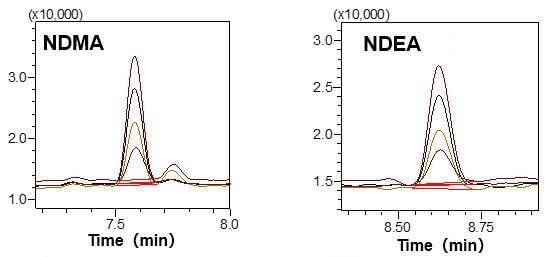
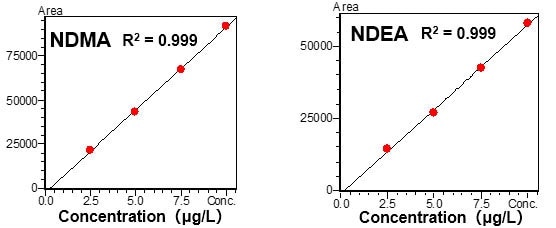
Standard solutions (DMSO solutions) prepared within the range of 2.5 to 10 μg/L of NDMA and NDEA, respectively, were measured with the HS-20 and the GCMS-QP2020 NX, to create chromatograms and calibration curves.
Favorable linearity was obtained with a contribution ratio (R2) of 0.999 for both components, well within the above-mentioned concentration range.
Concurrent Accuracy with the Headspace GC-MS
Utilizing the HS-20 and the GCMS-QP2020 NX, standard solutions (DMSO solutions) prepared with 5.0 μg/L of NDMA and NDEA, respectively, were injected repeatedly over six cycles, and the peak area values were calculated. Favorable repeatability was obtained even in the low concentration region of 5.0 μg/L.
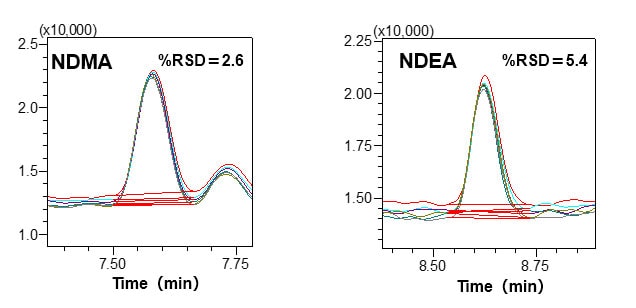
Repeatability
Valsartan bulk drug substances, Losartan bulk drug substances, and Olmesartan bulk drug substances were dissolved in DMSO at 5 % (w/v). Samples with NDMA and NDEA added to ensure final concentrations of 2.5, 5.0, and 10 μg/L were then subjected to additive recovery tests utilizing the HS-20 and the GCMS-QP2020 NX. Favorable results were obtained, with recovery rates in the range of 88 to 114 %.
| API | Valsartan | Losartan | Olmesartan Medoxomil | |||
|---|---|---|---|---|---|---|
| Con c. | Recovery Rate (%) | Recovery Rate (%) | Recovery Rate (%) | |||
| NDMA | NDEA | NDMA | NDEA | NDMA | NDEA | |
| 2.5 μg/L | 108.6 | 104.6 | 95.0 | 113.4 | 103.4 | 114 |
| 5.0 μg/L | 99.9 | 96.5 | 96.1 | 107.9 | 89.8 | 88.7 |
| 10.0 μg/L | 100.5 | 114.2 | 99.8 | 107.7 | 98.3 | 102.7 |
Conditions
| Headspace gas sampler | :HS-20 |
| Oven temperature | :120 °C |
| Sample line temperature | :125 °C |
| Transfer line temperature | :130 °C |
| Gas pressure for vial compression | :103 kPa |
| Vial warming time | :15 minutes |
| Vial compression time | :1 minute |
| Compression equilibration time | :0.10 minutes |
| Injection time | :1 minute |
| Needle flush time | :1 minute |
| Sample injection volume | :1 mL |
| GC Column: | :SH-PolarWax (30 m x 0.25 mm x I.D,0.50 μm) |
| Carrier gas | :He |
| Control mode | :Pressure |
| Oven temperature |
:40 °C(2 minutes)→10 °C/minute
→120 °C→ 25 °C/minute → 230°C(5-6 minutes)
|
| Solvent |
N, N-Dimethyl sulfoxide
|
| Instrument | GCMS-QP2020 NX with HS-20 |
| MS (EI Method) Ion source temperature | :200 °C |
| Interface temperature | :230 °C |
| Tuning mode | :Standard |
| Measurement mode |
:NDMA SIM(m/z 74.0)
:NDEA SIM (m/z 102)
|
| Event time | :0.30 seconds |
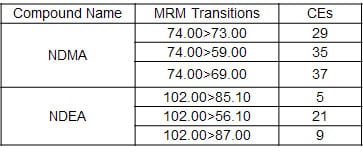
Analysis of NMDA and NDEA via Headspace GC-MS/MS
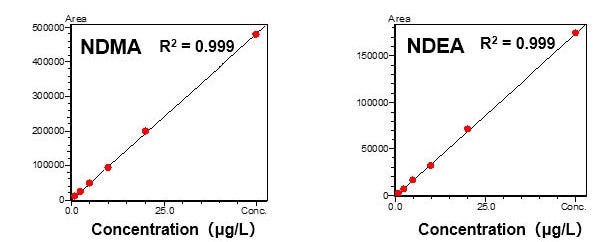
Standard solutions (DMSO solutions) prepared with 1.0 to 50 μg/L of NDMA and NDEA, respectively, were measured with the HS-20 and the GCMS-TQ8040 NX, to create chromatograms and calibration curves.
Favorable linearity was obtained with a contribution ratio (R2) of 0.999 for both components within the above-mentioned concentration range.
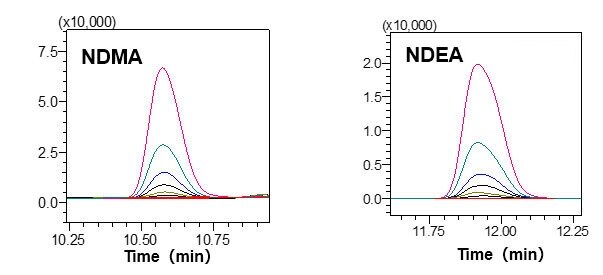
Concurrent Accuracy with the Headspace GC-MS/MS
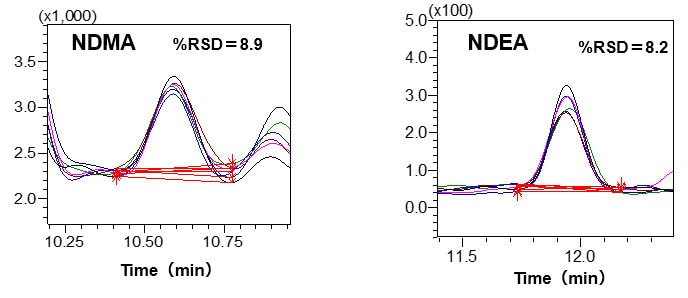
Utilizing the HS-20 and the GCMS-TQ8040 NX, standard solutions (DMSO solutions) prepared with 1.0 μg/L of NDMA and NDEA, respectively, were injected repeatedly over six cycles, and the peak area values were calculated.
Favorable repeatability results lower than 10 % were obtained, even in the low concentration region of 1.0 μg/L.
Repeatability
Valsartan bulk drug substances, Losartan bulk drug substances, and Olmesartan bulk drug substances were dissolved in DMSO at 2 % (w/v). Samples with NDMA and NDEA added to ensure final concentrations of 2.5, 5.0, and 10 μg/L were then subjected to additive recovery tests utilizing the HS-20 and the GCMS-TQ8040 NX. Favorable results were obtained, with recovery rates in the range of 83 to 119 %.
| API | Valsartan | Losartan | Olmesartan Medoxomil | |||
|---|---|---|---|---|---|---|
| Con c. | Recovery Rate (%) | Recovery Rate (%) | Recovery Rate (%) | |||
| NDMA | NDEA | NDMA | NDEA | NDMA | NDEA | |
| 2.5 μg/L | 109.5 | 858 | 101.2 | 83.0 | 113.3 | 119.1 |
| 5.0 μg/L | 97.4 | 100.5 | 101.9 | 99.1 | 114.2 | 96.1 |
| 10.0 μg/L | 103.7 | 105.9 | 106.4 | 110.4 | 119.4 | 100.9 |
Conditions
| Headspace gas sampler | :HS-20 |
| Oven temperature | :160 °C |
| Sample line temperature | :165 °C |
| Transfer line temperature | :175 °C |
| Gas pressure for vial compression | :80 kPa |
| Vial warming time | :25 minutes |
| Vial compression time | :1 minute |
| Compression equilibration time | :1 minutes |
| Injection time | :1 minute |
| Needle flush time | :1 minute |
| Sample injection volume | :1 mL |
| GC Column: | :SH-PolarWax (30 m x 0.25 mm x I.D,0.50 μm) |
| Carrier gas | :He |
| Oven temperature |
:40 °C(0 minutes)→8 °C/minute
→140 °C→ 25 °C/minute → 230°C(3-9 minutes)
|
| Solvent |
N, N-Dimethyl sulfoxide
|
| Instrument | GCMS-TQ8040 NX with HS-20 |
| MS (EI Method) Ion source temperature | :200 °C |
| Interface temperature | :230 °C |
| Tuning mode | :Standard |
|
|
|