


Sample Pretreatment for Optical Emission Spectrometry
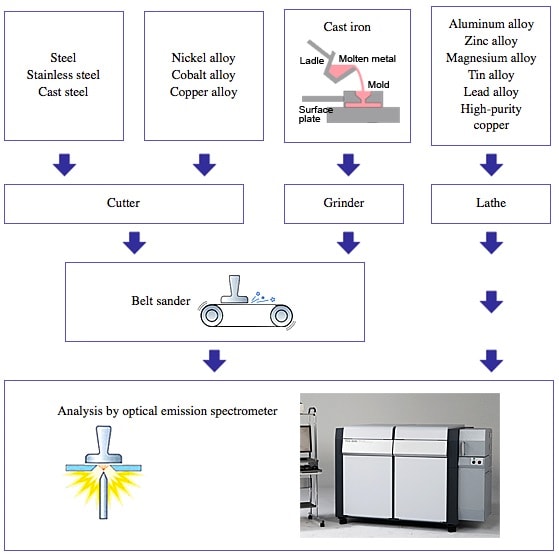
Samples are taken from molten metal, thin sheet, semi-complete or complete products. When sampling molten metal with a ladle, small quantities of molten metal are poured into a casting mold. Unnecessary parts of the sample are removed using a grinder or a cutter. As particles from a grinder may contaminate the surface of the sample, a lathe or milling machine is used (not a grinder) to cut soft samples such as white metal. If trace elements are not being investigated, a grinder or belt sander can be used. However, to minimize contamination, the grinding wheel or belt should be changed for each sample. Samples excised from semi-complete or complete products must be at least 12 mm in diameter. Small rod-shaped samples can be analyzed using special equipment.
News / Events
-
Comprehensive ICPMS Maintenance Videos: Keep Your Instruments Performing at Their Best
Our maintenance videos cover everything from detaching and mounting cones to cleaning glassware. These step-by-step guides help ensure your ICPMS performs at its best, preventing issues and extending its lifespan.
-
Energy Dispersive X-ray Fluorescence Spectrometer ALTRACE has been released
Detect trace elements with ease. A combination of optical system design and Shimadzu's proprietary high-speed signal processing technology allows ALTRACE to reach new heights in terms of sensitivity.
-
What is ICP-MS (Inductively Coupled Plasma Mass Spectrometry)?
Basics of Inductively Coupled Plasma Mass Spectrometry is now available.
-
Three Analytical and Measuring Instruments Win the Internationally Recognized “iF Design Award 2024”
The Shimadzu LCMS-2050 high-performance liquid chromatograph mass spectrometer, the Brevis GC-2050 gas chromatograph, and the ICPMS-2040/2050 ICP mass spectrometer won the internationally recognized iF Design Award 2024 in the product design category.
-
New Video: The Cabbage Core, Trash or Treasure?
Most people throw out the cabbage core when cooking, but is the core really just trash or actually a hidden treasure of nutrients?
-
New Video: ICPMS-2040/2050 ProActive Rinsing
ProActive Rinsing can shorten the analysis time by sharting the rinsing sequence in advance. While measuring multiple samples, the rinsing sequence can be started early by sending the autosampler probe to rinse while collecting data using sample already in the suction line. This greatly reduces measurement time and conserves sample.