


PPSQ-51A/53A Gradient System
Gradient System
Excellent Sensitivity Enables Analysis of Small Sample Quantities
Features
Equipped with a high-performance detector and a solvent delivery pump that provides excellent pumping performance even in the micro flowrate range
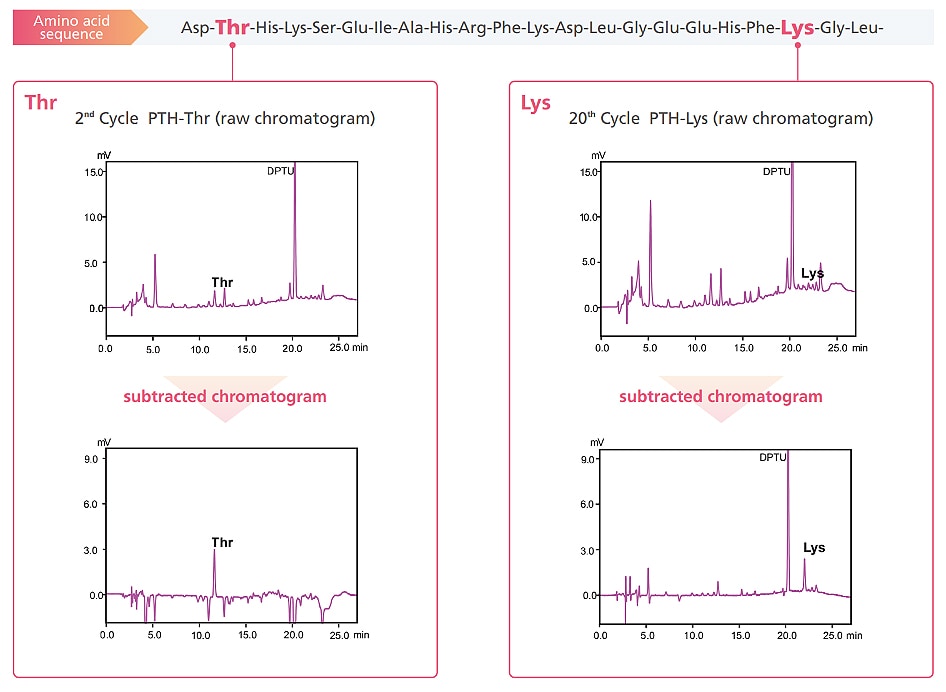
This system has high analysis stability because it is equipped with a high-performance detector and a solvent delivery pump that provides excellent pumping performance, even in the micro flowrate range, combine to ensure high analysis stability. Because chromatograms with good reproducibility can be obtained, peaks detected in the previous cycle can be canceled by performing differential chromatogram processing. This enables easy identification of PTH-amino acids even from trace samples.
Gradient separation enables high-sensitivity detection of PTH-amino acids
-
Chromatograms with good reproducibility can be obtained; peaks detected in the previous cycle can be canceled by performing differential chromatogram processing. This enables easy identification of PTH-amino acids even from trace samples.
- PTH-AA 10 pmol
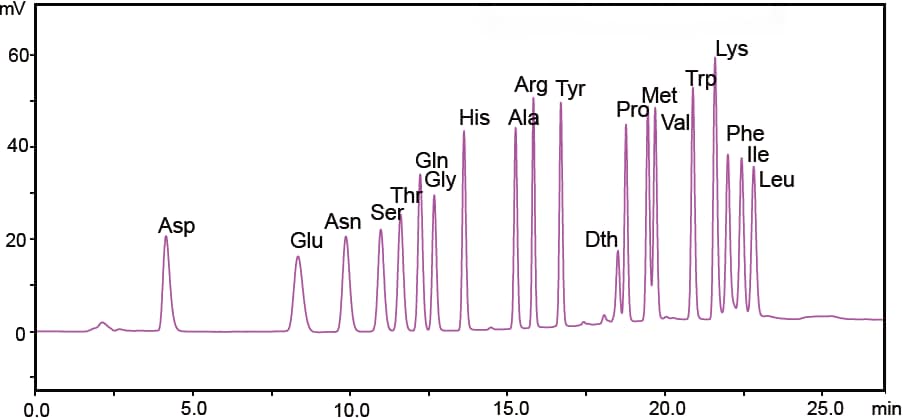
Analysis of PTH-Amino Acid
Analysis Stability
Example of Analyzing Bovine Serum Albumin (10 pmol)
For sequence analysis using a gradient system, reagents specifically designed for Edman degradation on gradient systems are used. This improves the analytical stability of gradient separation, and the subtracted chromatogram makes it easy to identify the PTH amino acid of specifically increased PTH-amino acids in each cycle. Here is an example of an analysis of bovine serum albumin.
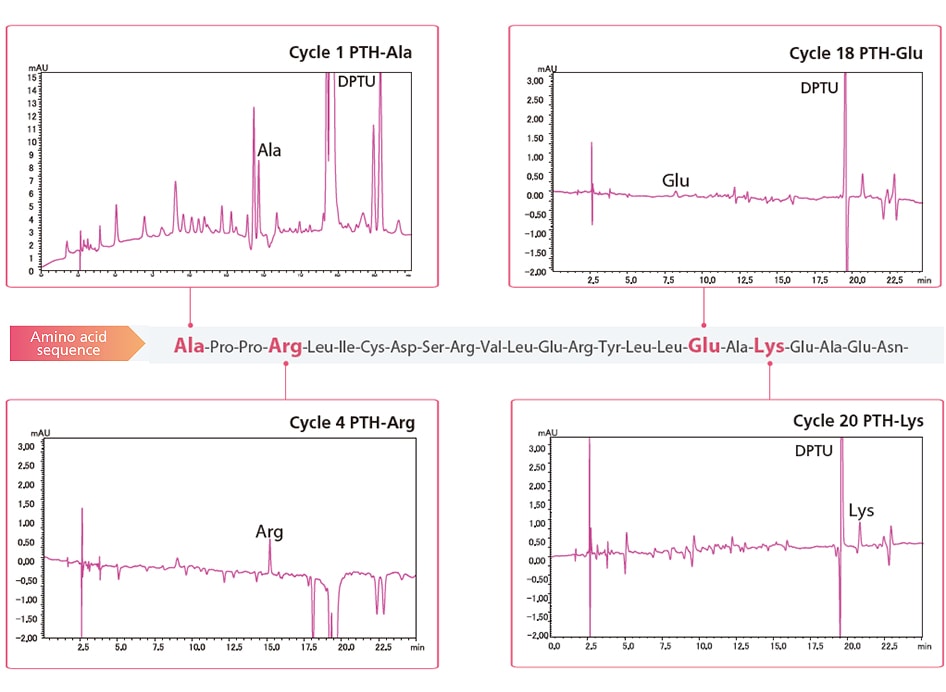
Cycle 1: row chromatogram, Cycle 4,18,20: differential chromatograms (EPO; CALBIOCHEM® cat# 329871, Human, Recombinant)
Example of High-Sensitivity Sequence Analysis Using Trace Samples
Analysis of Erythropoietin (2 pmol)
Erythropoietin is a hormone secreted by the kidney that stimulates red blood cell production.
Analysis of Reductively-Alkylated Cysteines
-
Disulfide (S–S) bonds formed by intramolecular cysteine (Cys) residues are a key component of protein and peptide tertiary structures. To identify unstable PTH-Cys in amino acid sequence analysis, proteins and peptides are subjected to reduction and alkylation to cleave disulfide bonds. The sample is then sequenced and identified as PTH-modified cysteine. Here, we present an example in which reduced and alkylated oxytocin was analyzed using the PPSQ-50A to identify PTH-modified cysteine. Several methods are available for reduction and alkylation of samples containing disulfide bonds. DTT (dithiothreitol) was used as the reducing agent, and alkylation was performed using iodoacetic acid for carboxymethylation (Cys (CM)), iodoacetamide for carbamidomethylation (Cys (CAM)), and 4-vinylpyridine for pyridylethylation (Cys (PE)). These modified cysteines can also be identified using the PPSQ-50A.
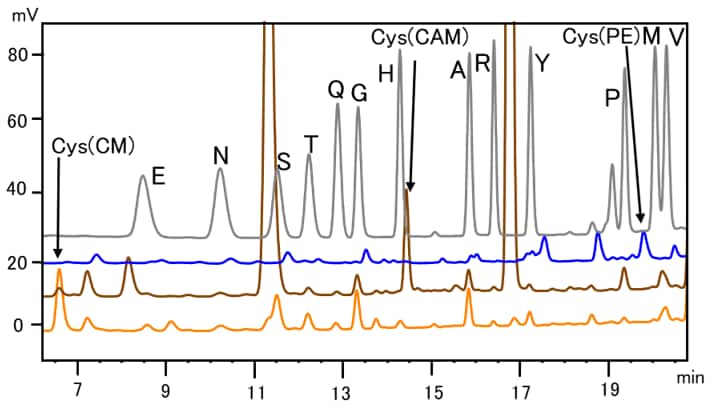
An example of the identification of a PTH-modified cysteine