Liquid Chromatography
Liquid Chromatography
Automation and Efficiency Improvement Solutions (HPLC and LC-MS)
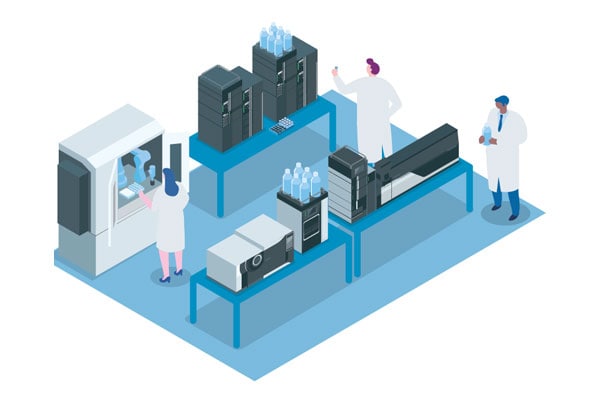
Just as robots equipped with AI functionality are offering major changes to our lives, continuous advancements in Shimadzu HPLC, LC-MS, data analysis software, and pretreatment systems are significantly changing how day-to-day analytical operations are performed.
Liquid chromatography (LC) is an analytical technique that affords high sensitivity in qualifying and quantifying compounds in liquid samples. LC instruments separate a sample mixture into its individual components. A mainstay of analytical chemistry, LC is invaluable when seeking highly sensitive data pertaining to even mere small particles – the level of precision and versatility offered makes LC a boon to a broad range of industries and applications. Further to this, LC is able to target existing compounds with minimal preparation of sample mixtures, which is why LC instruments are utilized in the fields of pharmaceuticals, food safety, environmental science and forensics. Shimadzu’s range of LC instruments offers cutting-edge advancements, with innovations that prioritize efficiency, ease of use and high performance with high-quality data output. With fast analysis times, automation options and intuitive software, Shimadzu’s advanced LC systems are designed to streamline processes while delivering high precision in every analysis.
Types of liquid chromatography
LC comprises a variety of techniques that can prioritize different benefits and are, therefore, used by certain industries and applications more readily. The major techniques of LC include:
High performance liquid chromatography
High performance liquid chromatography (HPLC) is a widely used technique that offers high resolution. An advanced form of liquid chromatography, HPLC incorporates a number of efficiencies due to the inclusion of a pump, which allows the solvent used in the analysis to travel under high pressure. This reduces the time it takes to separate molecules and boosts the speed of analysis, which is why it’s so invaluable to numerous industries.
Ultra high performance liquid chromatography
Taking efficiency a step further is ultra high performance liquid chromatography (UHPLC). UHPLC instruments separate sample compounds in a very short timeframe. While UHPLC offers superior separation, it demands the highest quality solvents and can be less cost-effective in the short term, although longer term the increased efficiency can reduce costs. Shimadzu offers HPLC and UHPLC instruments in both integrated and modular formats.
Size exclusion chromatography
Size exclusion chromatography (SEC) is focused on molecular separation based on size. Also known as gel filtration chromatography, this technique utilizes porous beads to give long elution time for small molecules and short elution time for large molecules. This technique is particularly useful when analyzing synthetic polymers and proteins.
Ion exchange chromatography
Ion exchange chromatography (IEX) is an analysis technique focusing on the charge-based separation of molecules. Using the difference of charge states between the target compounds, IEX can provide appropriated separation and is frequently applied to analyze ionic compounds via either anion exchange chromatography or cation exchange chromatography. The former separates based on molecules with negative charges, while the latter separates molecules with positive charges.
Affinity chromatography
Affinity chromatography is a powerful separation technique used to selectively isolate and purify target biomolecules from complex mixtures. It seeks to identify certain molecules by leveraging the selective and reversible bindings of many biological interactions, such as antibodies and antigens. It’s a highly selective approach that is becoming increasingly popular in many labs.
Across all of these types of LC, Shimadzu offers cutting-edge LC instruments, including LC software and LC components and accessories that incorporate innovations such as faster run times, higher resolution and improved automation. Shimadzu also offers enhanced LC consumables like advanced LC columns for better separation.
Applications of liquid chromatography
Owning to its versatility and reliability, LC is an ideal approach to analysis for a number of industries and specific applications. In the pharmaceutical and biopharmaceutical industries, LC is frequently used to test for drug purity as well as for metabolite identification. Similarly, clinical research and forensics look to LC for drug testing and disease biomarker analysis. Environmental science relies on LC for water and soil contamination detection. You’ll also see LC instruments utilized when testing for quality control and pesticide screening in food and beverage manufacturing.
Thanks to advanced high-throughput capabilities for large-scale testing and intuitive software for data management and compliance, Shimadzu’s suite of LC instruments and supporting software and accessories feature prominently across these industries and more. One such example is Shimadzu’s offering, which is used for quantitative analysis of catechins in tea leaves. You’ll find a host of application-specific uses for Shimadzu’s LC instruments here.
FAQs
What is liquid chromatography?
Liquid chromatography (LC) is an analytical technique that uses liquid to separate a sample mixture into its individual components. Following separation, the molecules are identified and recorded in a chromatogram. LC's high sensitivity and reliability mean that even mere trace amounts can be detected. LC specifically uses a liquid eluent as opposed to other approaches using a gas carrier.
What are the four types of liquid chromatography?
LC comprises four key techniques, which involve:
- High performance liquid chromatography (HPLC): Widely used because of the high resolution it offers. Ultra high performance liquid chromatography (UHPLC) is becoming more popular in labs because of its faster analysis and better separation.
- Size exclusion chromatography (SEC): Separates molecules based on molecular size.
- Ion exchange chromatography (IEX): Focuses on charge-based separation, divided into cation exchange and anion exchange.
- Affinity chromatography: Focuses on specific interactions of biomolecules to qualify and quantify sample mixtures.
What is the most widely used liquid chromatography method?
HPLC is the most widely used approach to LC because it’s versatile in application, highly accurate and prioritizes ease of use.
How is liquid chromatography used in real life?
LC is frequently utilized by labs in a broad range of industries. For its high reliability, fast analysis time and accuracy, LC is invaluable in the fields of pharmaceuticals, forensics, clinical research, food testing and environmental science.