LabSolutions Insight Explore™ - Features
Multi-analyte Screening Software
Streamlined Workflow for Unknown Compound Identification
LabSolutions Insight Explore offers streamlined capabilities for essential unknown compound identification workflows.
-
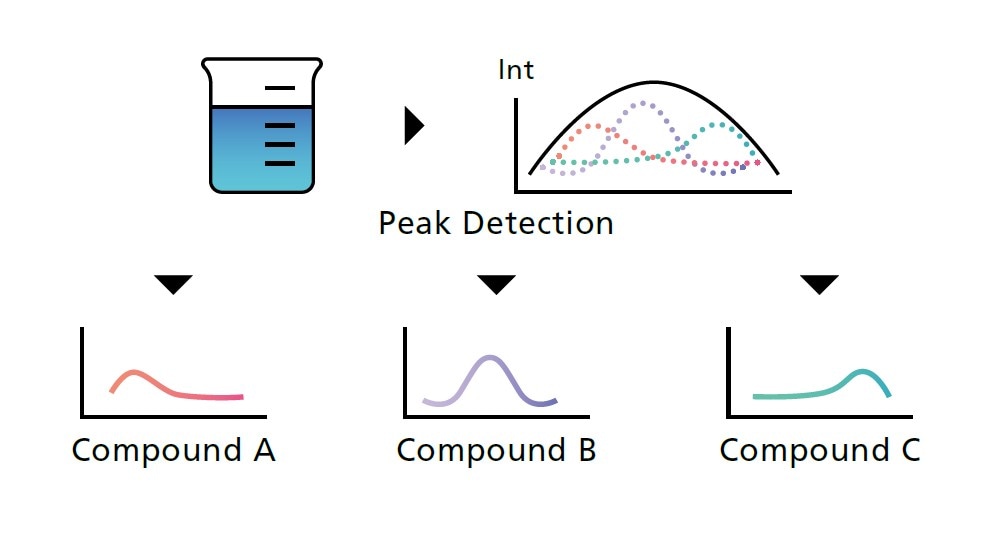
STEP 01: Candidates Detection
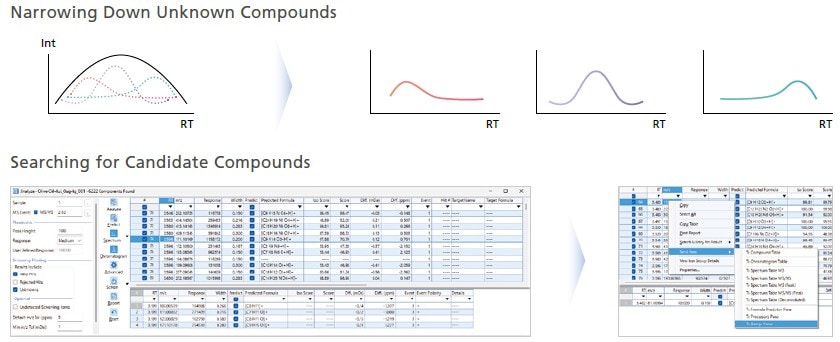
The system detects peaks corresponding to multiple potential compounds hidden within the chromatogram.

-
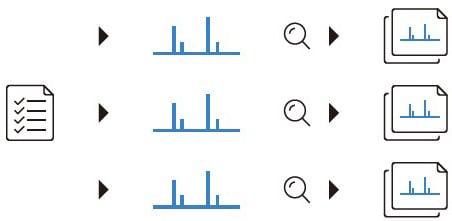
STEP 02: Screening
From the detected peaks, it searches for and identifies known compounds.
-
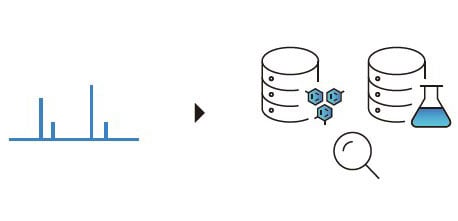
STEP 03: Unknown Compound Identification
For unknown peaks, users can review the chromatograms and spectra, perform library searches, and assign fragment ions to determine compound identities.
-
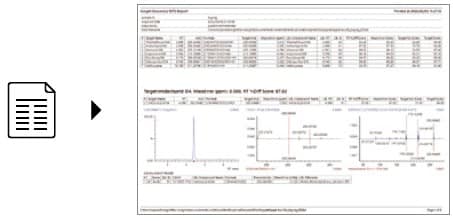
STEP 04: Report Generation
Identified compounds are consolidated and output as a comprehensive report.
Efficient Platform for Qualitative Analysis
Four core functions powerfully support qualitative analysis in high-precision mass spectrometry.
 ANALYZE
Core Capabilities that Power the Qualitative Workflow Candidates Detection Screening Unknown Compound Identification
High-resolution, high-mass-accuracy mass spectrometers generate enormous volumes of data, making peak identification, qualitative analysis, and quantitation increasingly complex. LabSolutions Insight Explore streamlines these processes with a simple, intuitive workflow that supports everything from qualitative assessment to quantitative analysis.
Analyze serves as the core application of LabSolutions Insight Explore, employing Shimadzu’s proprietary Detect algorithm to comprehensively identify peaks corresponding to unknown components within acquired datasets. Starting from Analyze, the software integrates seamlessly with applications such as formula prediction and library searching, enhancing the accuracy of unknown-component characterization and supporting downstream workflows for compound identification and quantitative analysis.
 ASSIGN
Rapid Structural Interpretation Using Fragment Information Unknown Compound Identification
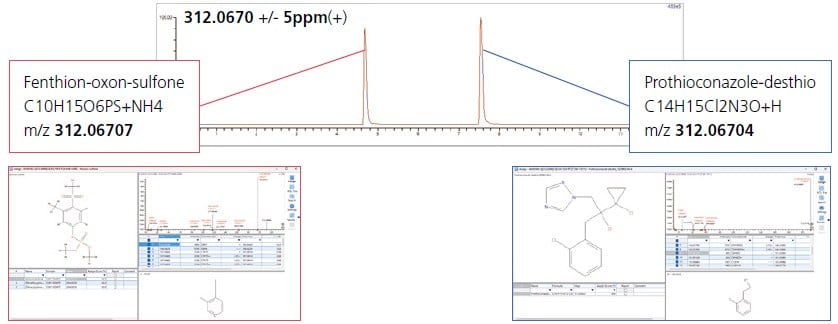
For each acquired high-resolution mass spectrum, the software retrieves candidate molecular structures from online databases and calculates fragment patterns based on those structures. These fragments are then assigned to the corresponding spectral peaks. The compound information obtained from database searches can be output as a candidate list, and the degree of fragment-assignment matching helps support the differentiation of isomers.
 PREDICT
Calculating the Composition of Unknown Compounds from Spectral Data Unknown Compound Identification
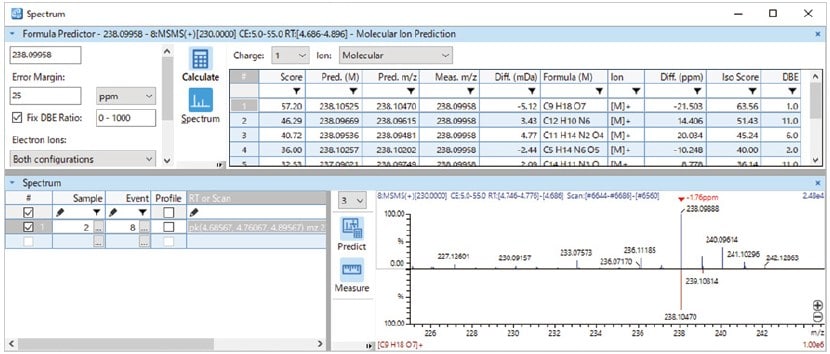
The software calculates elemental compositions based on the measured mass-to-charge ratios (m/z). It then compares the sample’s experimental spectrum with the theoretical spectra of candidate compounds, calculating a score that also accounts for isotopic patterns. These combined insights enable users to evaluate the compositional information of the spectrum with greater confidence.
 LIBRARY SEARCH
High-Speed, High-Performance Library Searching & Editable Results Unknown Compound Identification
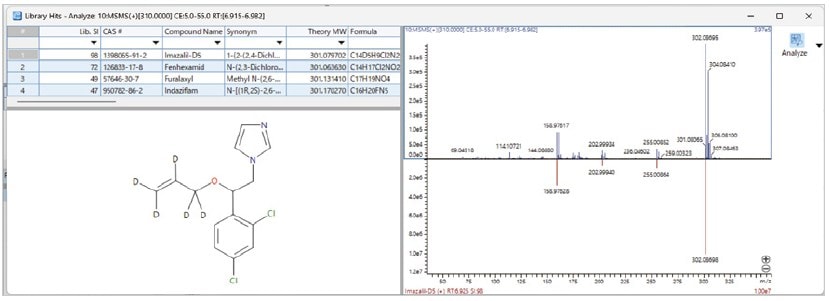
Library searches can be performed directly using MS/MS spectra. The high-speed, high-performance Insight algorithm rapidly retrieves theoretical spectra and structural information, allowing users to review results simultaneously within a single interface. A table-based library editor is also available, enabling easy modification of library entries.
Supporting a Wide Range of Qualitative Workflows
 Qualitative Batch Analysis of Large Sample Sets in Just Four Steps
In applications such as pharmacokinetic studies, illicit drug analysis, and residual pesticide testing, large numbers of samples must be processed under identical conditions. This includes performing qualitative analysis, screening for predefined target compounds, and generating reports summarizing component-detection results. LabSolutions Insight™ Discovery is an application designed to efficiently perform qualitative analysis. It supports this entire workflow—from qualitative analysis of hundreds of samples to final report generation—in just four simple steps.
STEP 01: Configure
- Set up the qualitative batch workflow. In addition to component detection, you can configure screening and library search options.
STEP 02: Load
- Import the data files and any associated files required for analysis. Additional data files can be added later as needed.
STEP 03: Run
- Begin qualitative analysis for all samples with a single click.
STEP 04: Report
- Output qualitative analysis results for all samples in MTS format with one click. The report can be used as evidence for component detection results.
Note: LabSolutions Insight Discovery is available only with the file-management version of the software.
 Integrated MS Spectra and LC Chromatograms for Impurity Analysis
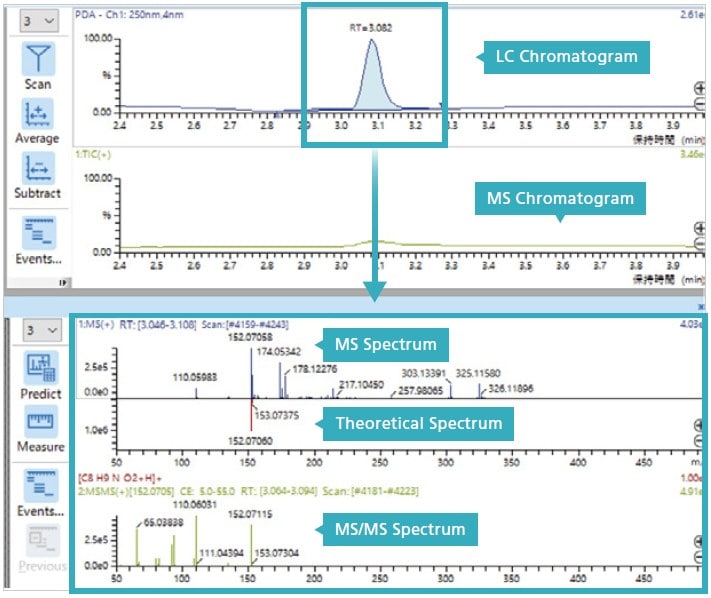
The software allows flexible on-screen arrangement of LC and MS chromatograms and spectra, enabling the display of LC and PDA chromatograms alongside MS data. When used together with LC detectors, this capability supports detailed structural analysis of impurities. For example, in pharmaceutical applications, impurities detected by UV or PDA detectors can be further examined by using MS spectra to determine their structures.
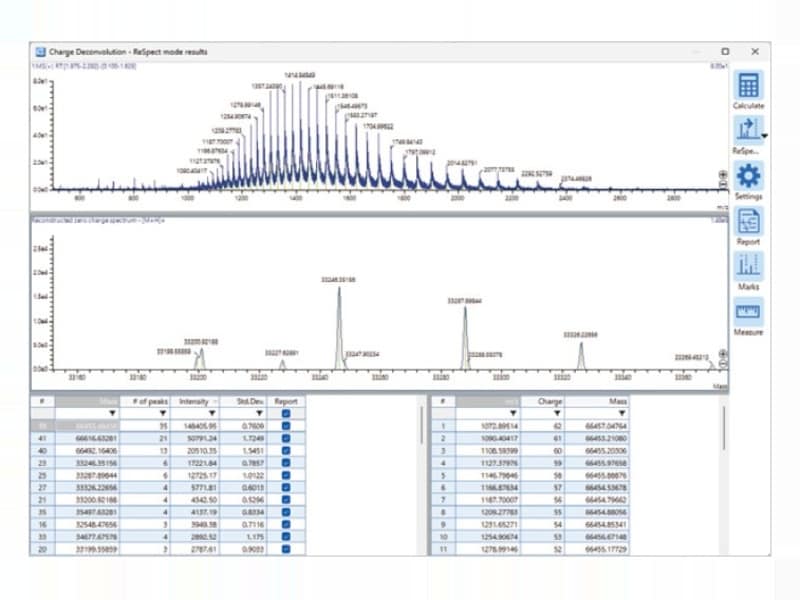
 Multi-charged ion analysis algorithm for compounds with high molecular weight
LabSolutions Insight Explore CSD (Charge State Deconvolution) supports multi-charged ion analysis for compounds with high molecular weight. It adopts a multi-charged ion analysis algorithm from Positive Probability Limited that can handle high charge states. This capability is particularly useful for analyzing macromolecular compounds such as peptides.
Note: LabSolutions Insight Explore CSD is an optional software for LabSolutions Insight Explore.