


ELEM-SPOT - Features
Element Selective Gas Chromatograph Mass Spectrometer
Spotting Targets Selectively
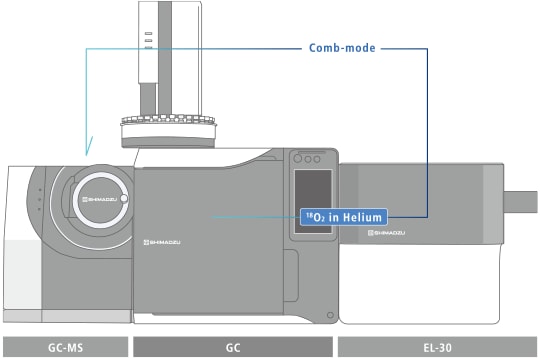
Hydrocarbon compounds are first separated by GC and then oxidatively dissociated in the element-selective combustion unit. Then the separated compounds are detected by MS using the selected ion monitoring (SIM) mode. As a result, the difficult analysis of trace quantities of an oxygenated compound was enabled by using isotopic oxygen (18O2) as the oxidation gas (Pat. No. WO 2017/114654). Furthermore, nitrogen-containing compounds can be detected selectively by using regular oxygen (16O2) as the oxidation gas.
-
GC-Comb-MS Mode
The GC-Comb-MS mode is a configuration where an element-selective combustion unit is connected after the GC and before the MS. In this mode, oxygen/nitrogen-containing compounds can be selectively detected. After separating hydrocarbon compounds with GC, the compounds are oxidatively decomposed in the combustion catalytic reactor and detected using the SIM mode.
-
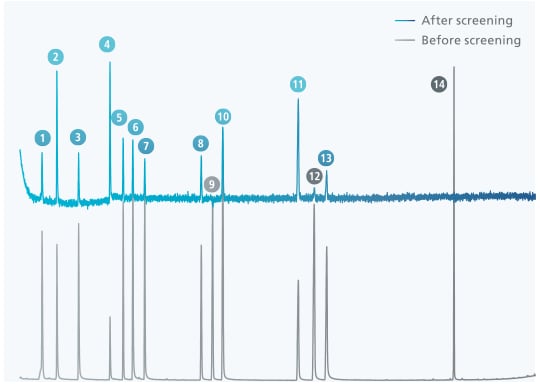
MS Chromatogram from GC-Comb-MS (Oxygen Content Analysis)
-
-
(1) Cyclohexanone (8) Hexylbutyrate (2) 2-ethoxyethylacetate (9) Dodecane (3) Benzaldehyde (10) Phenethyl acetate (4) Dimethyl malonate (11) Dimethyl phthalate (5) 2-pentyl butyrate (12) Acephatene (6) Acetaldehyde (13) Dibenzofurane (7) 1-octanol (14) Eicosane Note: This provides a unique chromatogram that can be used to determine whether compounds contain oxygen.
Compounds 9, 12, and 14 do not contain oxygen.
MS Direct Mode
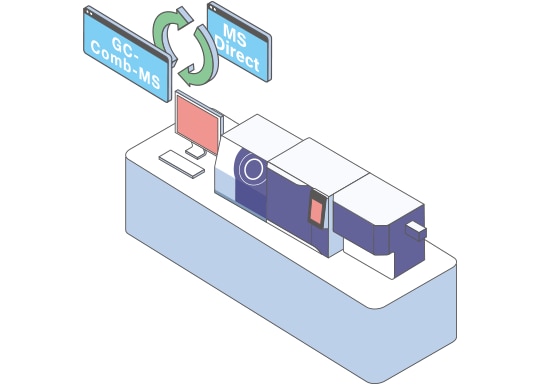
The MS Direct mode is a common configuration in GC-MS. The ELEM-SPOT system enables analysis in a typical GC-MS setup without passing through the element-selective combustion unit by switching the configuration flow paths.
Securing a Seamless Workflow
-
The GC-Comb-MS mode enables selective analysis of specific heterocyclic compounds with high sensitivity while the MS direct mode enables conventional GC/MS analysis. Each mode can be specified and controlled easily using the LabSolutions™ system control software, allowing both modes to be used quickly and conveniently for analysis.
-
-
Automated Switching between Oxidation Gases
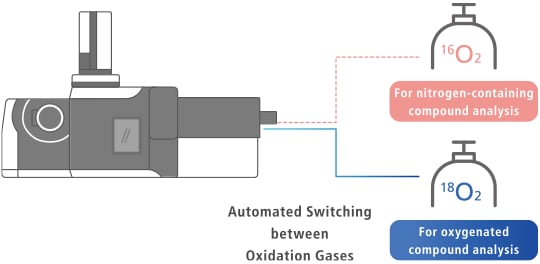
In GC-Comb-MS mode, Shimadzu’s unique GC gas selector can automatically switch between oxidation gases for trace analysis of either oxygen or nitrogen.
-
Simplified Routine Maintenance
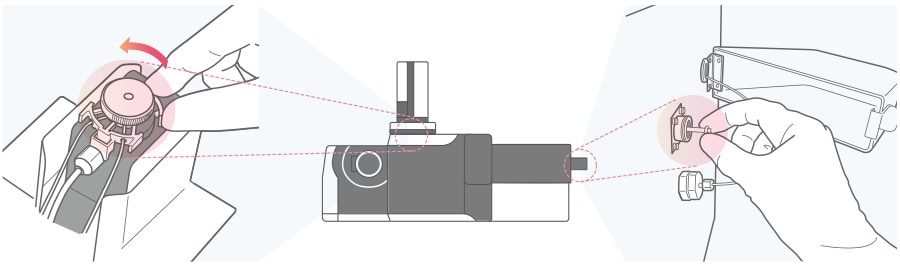
-
One-Step GC Injection Port Maintenance
Systems are equipped standard with ClickTek™ nuts that enable one-step maintenance of a sample injection port without using a tool to open/close the sample injection port.
-
Easier Reaction Tube Replacement
The reactor is oriented horizontally to provide easier access to the reaction tube and eliminate the need for reactor disassembly for the tube replacement.
Supporting Cutting-Edge R&D
The ELEM-SPOT system can provide analysis results that are essential for researching and developing biomass, chemical recycling, and other solutions for achieving a carbon-neutral society.
-
Analysis of Oxygenated Compounds in Wood Bio-Oil
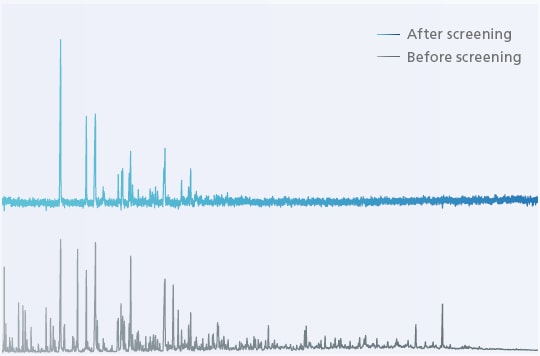
Biomass used as a raw material for bio-oils can contain large amounts of oxygenated compounds that can damage the catalysts used during oil purification. Therefore, such compounds must be identified and removed.
-
Changes in the Catalytic Ability of Hydrotreating Phenols Over Time
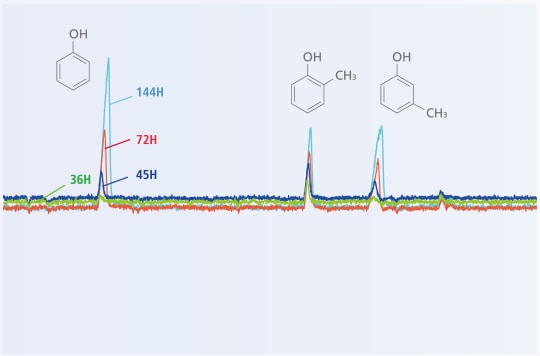
Note: As the continuous usage time of the catalyst increases, it can be seen that oxygen-containing components such as phenols are not processed.
Because the ELEM-SPOT system can uniquely identify oxygenated compounds in countless matrices, it can be useful for quickly checking the effectiveness of oxygenated compound removal capacity over time.
Analysis of Nitrogen-Containing Compounds in Bio-Oils Derived from Algae
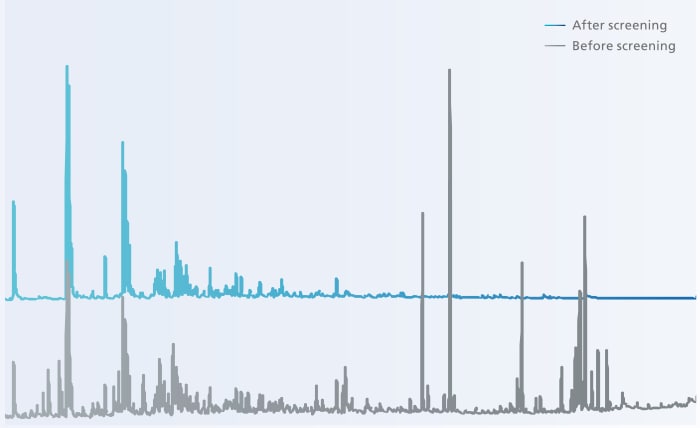
Algae, which has attracted attention as a raw material for bio-oils, contains many nitrogen compounds. However, nitrogen compounds can affect catalytic performance during hydrogenolysis, so they must be appropriately treated before bio-oil purification. Shown above is a chromatogram of bio-crude oil derived from algae and a chromatogram of specifically detected nitrogen compounds in crude oil. In addition to oxygenated compounds, the ELEM-SPOT system can specifically detect compounds that contain nitrogen atomic configurations.