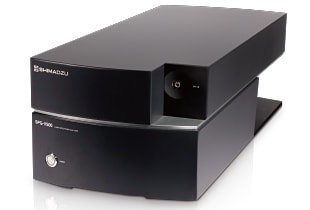


Visualization of Terahertz-Wave Signals
Terahertz waves have been the target of much active research in recent years due to their potential use in various applications, such as next-generation communications and non-destructive inspection. The Tera-Photonics Research Team at the RIKEN Center for Advanced Photonics, RIKEN has successfully developed a palm-sized terahertz-wave source, a major goal they pursued for many years. Meanwhile, research on terahertz-wave detection, which was being developed in parallel with the development of the terahertz-wave source, was having difficulty measuring signals that would determine the success or failure of experiments. The key to overcoming this situation and contributing to the success of the terahertz-wave detection experiment was the SPG-V500 laser spectrum analyzer. We asked Hiroaki Minamide, the Team Director, and researchers Deepika Yadav and Yuma Takida, who carried out the work, about the circumstances at that time.
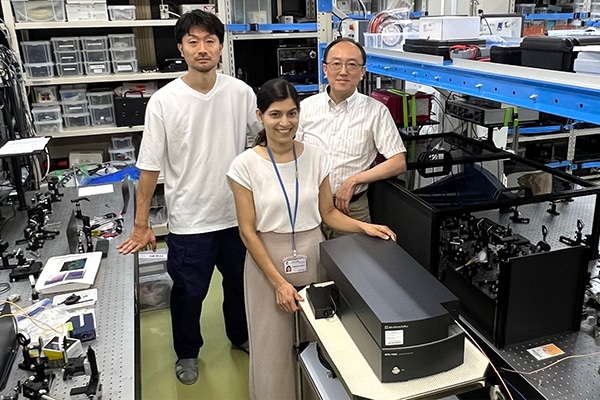
Hiroaki Minamide, Team Director (right), Deepika Yadav, Research Scientist (center), and Yuma Takida, Research Scientist (left)
In the Research Laboratory of the Tera-Photonics Research Team, RIKEN Center for Advanced Photonics, RIKEN
- Palm-Sized Terahertz-Wave Source Completed—Fulfilling a 25-Year Dream
- Terahertz-Wave Detection Paired with Source
- Detection of Signals Extremely Difficult
- The Signals Appear - "We did it! We can see them!"
- Key Features of the SPG-V500 Used to Achieve Signal Detection
- Detection Technology Opens Door to New World of Quantum Research
Palm-Sized Terahertz-Wave Source Completed-Fulfilling a 25-Year Dream
Terahertz waves are electromagnetic waves that fall in the frequency range between radio waves and infrared radiation (from about 100 GHz (= 0.1 THz) to 10 THz). Unlike X-rays, terahertz waves do not damage biological tissue. Yet, they can penetrate materials easily and travel in a straight line, so it has long been hoped that they could be used in various fields, such as communications, healthcare, and testing. However, developing practical sources (generators) and detectors has been difficult, and they have yet to be put to wide practical use.
Hiroaki Minamide of the Institute of Physical and Chemical Research (RIKEN) has been engaged in research aimed at developing a practical terahertz-wave source for many years. He has been researching terahertz waves for over 25 years since a time when terahertz waves were still a minor field of study. In September 2024, he finally announced that he had achieved his long-held goal of developing a palm-sized, high-output terahertz-wave source (Fig. 1). He shared the following comments.
"Though several methods can generate terahertz waves, our research focused on generating terahertz waves by shining laser beam onto a nonlinear optical crystal (*1) that converts the laser wavelength to terahertz waves. As a result of many years of research on ways to increase that output level sufficiently, we found a way to increase output by 100,000 times immediately (*2). After additional research, we finally succeeded in completing a terahertz-wave source that is both compact and offers high output."
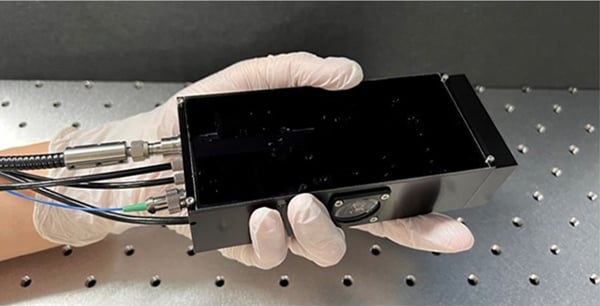
Fig. 1 Palm-Sized Terahertz-Wave Sourceⅰ
Source: RIKEN
Terahertz-Wave Detection Paired with Source
Meanwhile, a terahertz-wave detection method was also developed in combination with the source. Though multiple detection methods were already available, there were no widely available methods for detecting low-frequency sub-terahertz waves at room temperature with high sensitivity. Therefore, they used an SPG-V500 analyzer in research to achieve such a method.
Minamide explained how the path to developing the detection method became clear as he continued to develop the source.
"Simply put, the terahertz-wave source we developed is a device that converts laser beam to terahertz waves. Detection is the opposite of this; in other words, it converts the terahertz waves back into optical signals. Therefore, we thought it would be possible to develop a detection method using the technology we had used during source development."
The principle for detection is as follows (Fig. 2). First, pump beam(i.e., laser beam) and terahertz waves are simultaneously input into a nonlinear optical crystal. It is known from theory that when pump beam and terahertz waves pass through a crystal, the wavelengths are converted to generate SFG (sum frequency generation) signal, with a frequency equal to the sum of the two frequencies, and DFG (difference frequency generation) signal, with a frequency equal to the difference between the two frequencies. In other words, if the two types of optical signal, SFG and DFG, can be observed, then the incidence of terahertz waves can be confirmed.
The research into terahertz wave detection was carried out based on this principle.

Fig. 2 Principle of Terahertz-Wave Detection Using a Nonlinear Optical Crystal
Detection of Signals Extremely Difficult
The person in charge of the terahertz-wave detection research was Deepika Yadav.
"The research aimed to achieve detection of sub-terahertz waves, or in other words, terahertz waves with a frequency lower than 1 THz, using an organic nonlinear optical crystal made of BNA. Though the detection of terahertz waves using an organic nonlinear optical crystal had already been achieved, only waves in the 1 THz or higher frequency band had been detected. Therefore, attempting to detect sub-terahertz waves was of great significance."
Starting from nothing, Yadav researched sub-terahertz-wave detection while consulting with Yuma Takida, a key researcher involved in developing the source, and spent several months constructing an optical system for detection (Fig. 3).
When terahertz waves generated using a nonlinear optical crystal made of PPLN and pump beam from a laser are both input to a BNA crystal with the two on the same axis, the optical beam that passes through the BNA crystal should contain both SFG and DFG signal components, based on the principle described above. If those signals can be detected, it means terahertz waves have been detected.
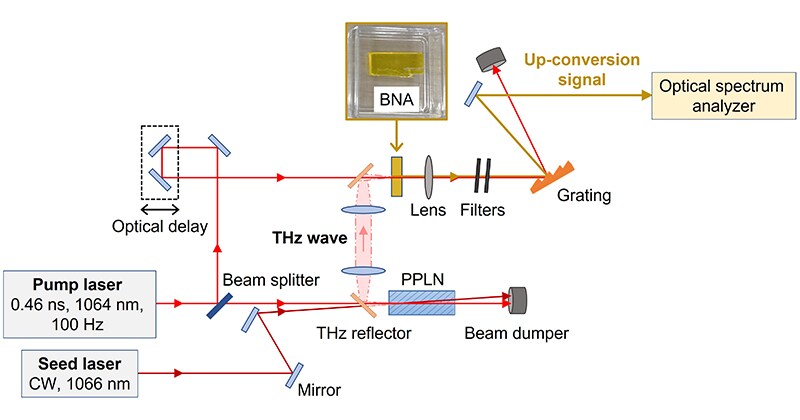
Fig. 3 Schematic of Experimental System for Sub-Terahertz-Wave Detection Constructed by Yadav and her Colleagues
Source: RIKEN
After numerous experiments, the research team finally reached the SFG and DFG signal detection stage, but detection proved extremely difficult. That difficulty is the reason sub-terahertz waves had not been detected previously. Yadav commented about that as follows.
"The SFG and DFG signals we tried to detect are emitted along the same axis as the powerful pump beam. In other words, both signals are mixed together. Moreover, the difference between signal and pump wavelengths is tiny because it only corresponds to the energy level of sub-terahertz waves. Compared to the pump wavelength of about 1064 nm, the wavelengths of the detected signals are about 1062 nm (SFG) and 1066 nm (DFG). In addition, the pump beam is very strong, but the signals are extremely weak. Furthermore, because it is optical pulse, the signal only occurs momentarily. It’s like searching for a drop of ink mixed into an ocean."
Yadav’s team tried a variety of methods. For example, they tried inserting a filter to weaken the pump beam and inserting a diffraction grating to separate only the signals, but even after repeatedly making adjustments and measuring the results, they were unable to detect any signal. They even thought that maybe no signal was being generated at all. Though, theoretically, the signals should be emitted, perhaps there was a mistake somewhere in the experiment. Those were the types of feelings they eventually faced. So what should they do? Just when they were feeling stumped, an email caught Minamide's attention.
The Signals Appear-"We did it! We can see them!"
Minamide recalled how "It happened at the end of 2023. I noticed the words ‘real-time measurement’ in an email describing the SPG-V500 laser spectrum analyzer. When I saw that, I thought, 'just maybe'."
In early 2024, they ordered a demo unit and tried using it. Takida, who was conducting the experiment with Yadav, described how it happened.
"We had made adjustments to the unit, took a measurement and immediately started seeing very weak but characteristic signals. I thought, ‘could it be?’ However, it took some time to make accurate measurements because the laser pulses still needed to be synchronized, and the experimental system still required spatial adjustments. When all the adjustments were finished, and the measurements were repeated, the signal suddenly grew stronger. There was no doubt about it. It was definitely the signal we were looking for (Fig. 4). When we saw that, we all cheered, 'We did it! We can see them!'"
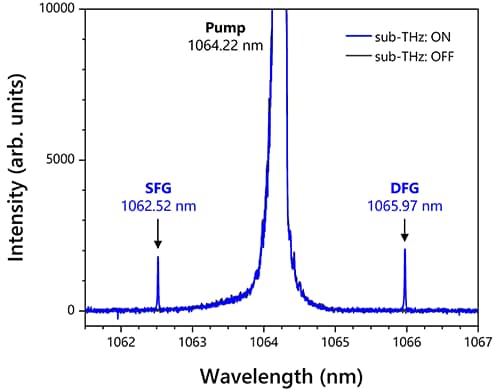
Fig. 4 Spectra that Show the Sub-Terahertz-Wave Signals Converted to Wavelengths in the Near-Infrared Region
Measurements using the SPG-V500. The targeted signals are shown as two peaks on the left and right (SFG on the left and DFG on the right). The peak in the center is from the laser pump beam. The two peaks on the left and right did not appear when the sub-terahertz wave was not input.
Source: RIKEN
Key Features of the SPG-V500 Used to Achieve Signal Detection
Why was signal detection possible with the SPG-V500? How is it different from other optical spectrum analyzers? The biggest factor was the real-time measurements obtained with an array sensor, a key feature of the SPG-V500. The large number of sensors means it can simultaneously measure multiple spectra within a certain range. In contrast, scanning optical spectrum analyzers measure spectra by successively scanning each wavelength. Therefore, for their research, where a pulsed laser is used, scans must be synchronized with the instant the pulse signal arrives, which made getting the timing right extremely difficult. Using SPG-V500 real-time measurements, even signals that only appear instantaneously can be easily measured.
Moreover, because the SPG-V500 is capable of high-resolution measurements of about 0.02 nm using a multi-mode fiber input, it was able to capture the extremely weak signals studied in this research.
Yadav described her impressions of using the SPG-V500 as follows.
"The SPG-V500 real-time measurement capabilities not only made signal detection possible but also made measurement itself really easy. Previously, signals had to be checked while delicately adjusting the position at each frequency, which required massive amounts of time for measurements, but the SPG-V500 completely eliminated the need for such steps, making detection easy. Furthermore, using a multi-mode fiber normally reduces resolution, but the SPG-V500 was able to couple many signals while maintaining high resolution. That is what made it possible to detect such weak signals."
Click here for more about Laser Spectrum Analyzer SPG-V500
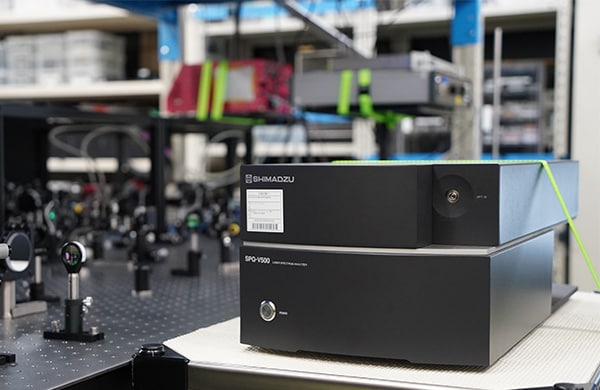
Fig. 5 SPG-V500 Laser Spectrum Analyzer
In the Research Laboratory of the Tera-Photonics Research Team, RIKEN Center for Advanced Photonics, RIKEN
Detection Technology Opens Door to New World of Quantum Research
Yadav presented the results in September 2024 at the International Conference on Infrared, Millimeter, and Terahertz Waves (IRMMW-THz 2024) in Australia, where her presentation was met with a very positive response. Though the path to practical application will not be smooth, the research results have opened up new possibilities for detecting terahertz waves. Looking beyond this research, the development of detectors is not the end of the story. Yadav explained that as long as they keep plugging away at the research, a whole new world will open up.
"In the current research, a remaining challenge is how to clearly separate the signals from the pump beam. If we can make improvements in this area, or, in other words, increase the sensitivity of terahertz-wave detection to an extremely high, close to the point where we can detect individual photons using terahertz technology, we think it would open up a new world of quantum research using terahertz waves. Keeping such a future in mind, we remain committed to developing this research further and making more advancements."
Notes:
- *1: Nonlinear optical crystals: Crystals that exhibit a nonlinear response to incident optical field and that are used to convert the wavelength of laser beam. Among the wide variety of nonlinear optical crystals available, the ones used most frequently in the past have been inorganic crystals. The PPLN (periodically poled lithium niobate) crystal used in the terahertz-wave source developed by Minamide’s team is also an inorganic crystal. In contrast, the BNA (N-benzyl-2-methyl-4-nitroaniline) crystal mentioned in this article is organic. It has a larger nonlinear optical constant than inorganic crystals, which makes it better suited to generating and detecting terahertz waves over a wide range of frequencies
- *2: Minamide and his colleagues succeeded in developing the source itself in the 2000s, but the device was very large, and the output was low. Achieving a more practical terahertz-wave source required making the device smaller and the output much higher. Research had been based on trying to identify terahertz waves among the scattering process (stimulated Raman scattering) that was generated when laser beam was input into the crystal, but then he noticed in the notes of a past experiment that separate competitive scattering process in the crystal (stimulated Brillouin scattering) was interfering with the stimulated Raman scattering. Therefore, he removed the stimulated Brillouin scattering, which significantly increased stimulated Raman scattering efficiency and increased output by 100,000 fold in a single jump.
References:
| ⅰ | September 6, 2024, RIKEN Press Release "Development of Palm-Sized High-Power Terahertz-Wave Source—Offers Path to Various Practical Applications for Non-Destructive Inspection—" (contents of this article is available only in Japanese) https://www.riken.jp/press/2024/20240906_1/index.html |
| ⅱ | Deepika Yadav et al.: Sub-Terahertz Wave Detection Using Frequency Up-Conversion in Organic BNA Crystal, The 49th International Conference on Infrared, Millimeter and Terahertz Waves (IRMMW-THz 2024) |
Related Links
Improvement Case Study Improving Spectral Measurements of Difficult-to-Detect Pulsed Lasers
Improvement Case Study Detecting Side Mode Behavior in Single-Mode Lasers