
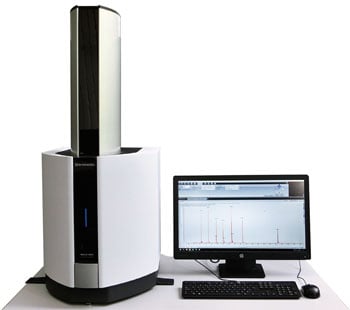
MALDI-8020


MALDI-TOF Mass Spectrometry
Proteins may now be easily identified using trypsin digestion pretreatment and a mass spectrometer. This type of workflow is well-established and is accessible even to non-MS experts. In such workflows, protein identification is achieved through simple database searching with a search engine, such as Mascot (Matrix Science). However, in the case of terminal sequence analysis of proteins that have undergone processing or mass spectrometric identification of proteins from minor biological species not listed in databases, more expensive high-end instrumentation and more complex workflows, requiring skilled operators, are often employed. Furthermore, protein sequencers are generally used as a method for protein terminal sequence analysis; but in the case of N-terminally blocked proteins, de-blocking is necessary as a pretreatment to perform analysis. The pretreatment may not work well depending on the protein type and therefore requires a level of skill/experience which may limit its use. In recent years, it has become possible to analyze the sequence of proteins whose N-terminal is blocked or which are not registered in databases by utilizing protein fragmentation that occurs in the ion source (ISD: In-Source Decay) of MALDI-TOF mass spectrometers. In addition, ISD is theoretically not restricted by the mass of each sample, so high-mass proteins can be sequenced directly without trypsin digestion. Nevertheless, since ISD requires the target protein to be isolated and purified, protein sequence analysis by ISD has yet to gain popularity with non-experts of mass spectrometry. As a solution to such problems, this article introduces an example of combining protein extraction from electrophoresis gels.
September 19, 2018 GMT