
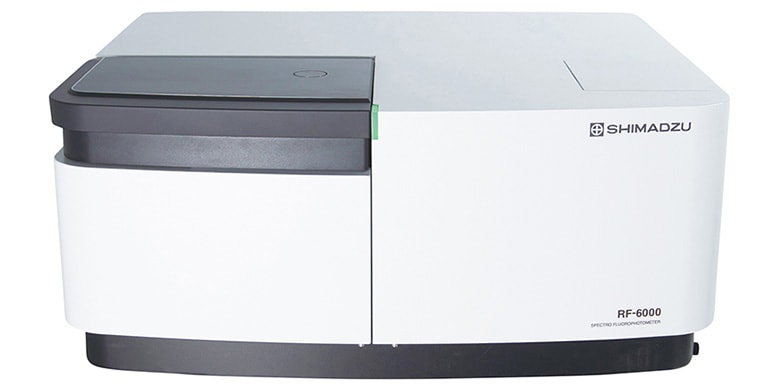
RF-6000


Spectrophotometric Analysis
Absorbance spectra and fluorescence spectra make it possible to investigate the transitions in the state of electrons (ground state, excited state, etc.). There are many laws regarding the state of electrons such as Kasha's rule and the Franck-Condon principle, but more complex phenomena and exceptions are known to exist. In particular, regarding light emissions of organic substances, peak positions and shapes change significantly depending on the molecular structure and the effects of interactions with the surroundings. Points considered to be factors of influence include spatial structure, isomerization, solvent polarity, viscosity, and pH. In Application News No. A533, we introduced the excimer emission of pyrene as an example of an emission transition where there are two different molecules. This article introduces measurements of a sample which exhibits differing fluorescence when in a polar solvent and in a nonpolar solvent, and a sample which starts emission from the second excited singlet state (S2 state) both using the RF-6000 spectrofluorophotometer.
March 12, 2018 GMT
