
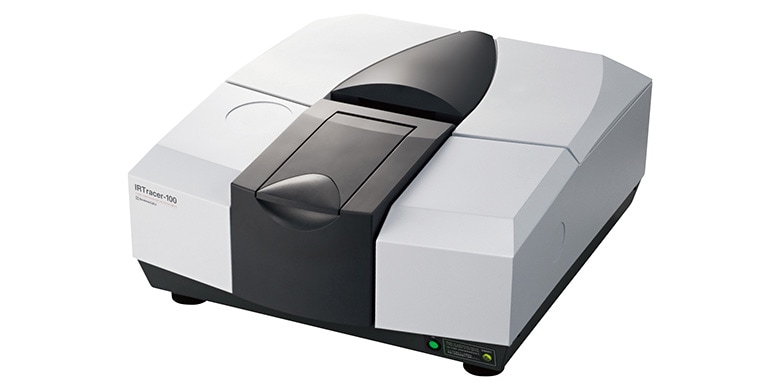
IRTracer-100


Modifying cement formulations with polymers provides many important properties that make a variety of niche applications possible. Addition of polymers such as ethylene vinyl acetate copolymer (EVA) or styrene butadiene rubber (SBR) to cement helps to improve the workability, adhesion, curing performance, strength and durability of the cement mortar and concrete. Properties of the polymer modified mortar and concrete are influenced by polymer-cement ratio. Thus, the polymer-cement ratio should be determined to meet the desirable requirements. Fourier Transform Infrared (FTIR) spectroscopy is a useful technique in the identification of the polymer due to its characteristic absorption in the infrared (IR) region. FTIR spectroscopy in combination with chemometrics data analysis method, such as principle component regression (PCR), multi-linear regression (MLR) or partial least squares (PLS) regression, has often been used for quantitative analysis of multicomponent. This combination enables a rapid and simultaneous determination of each component concentration in a mixture without time consuming sample preparation and measurement. Thermogravimetry (TGA) is an empirical method where the mass of a substance, heated at a controlled rate in an appropriate environment, is recorded as a function of time or temperature. Mass change over specific temperature ranges and in a specific atmosphere provides a compositional analysis of that substances. As mass change can be due to chemical reactions such as vaporization, decomposition and oxidation, TGA can be used for quality control and material screening as a comparison can be made with a known material of the same type. This paper examines the determination of polymer type and polymer content in construction materials using FTIR and TGA. The use of FTIR with chemometrics as an alternative or supporting method in polymer content determination is also explored.
January 25, 2016 GMT