
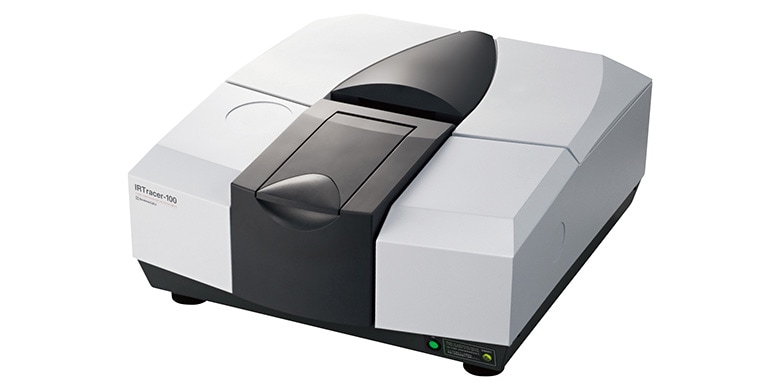
IRTracer-100


Spectrophotometric Analysis
The KBr pellet method is a technique mainly used to measure solid samples. This method exploits the plasticity of alkali halides that form a transparent plate when subjected to pressure. While potassium bromide (KBr) is the most common alkali halide used in pellet formation, potassium chloride (KCl) and cesium iodine (CsI) may also be used. Conventionally, pellets were formed by pulverizing KBr and the measurement sample each with an agate mortar, mixing the two to an appropriate concentration, and then applying pressure. However, compared to its crystallized state, crushed KBr readily absorbs moisture and there is also a risk of contamination from the mortar. Furthermore, press-forming work was a burden to analysts and preparing concentrations also took time. By using KBr Cuttings, the onerous tasks of pulverizing KBr and mixing it with samples using an agate mortar are no longer required. KBr Cuttings are plates of cut KBr crystals. Good quality KBr disks can be produced by simply setting the sample for measurement between two KBr plates, placing the combination into a pelletizer, and applying pressure. When using KBr Cuttings, FTIR measurement is done using the transmittance mode. In this mode, the detector receives a greater amount of light compared to that with the reflectance mode and the ATR method, and therefore features measurement with good sensitivity. In Application News No. A536, we introduced the procedure for using KBr Cuttings and an example analysis of pharmaceutical identification testing. In this article we introduce an example analysis of food contaminants using KBr Cuttings.
September 11, 2017 GMT