
CDD-10AVP


High Performance Liquid Chromatography
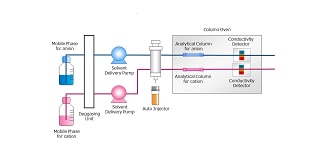
Plating solution and wastewater from plating plants contain multiple ions including those of sodium and ammonium. Ion chromatographyisusedtoquantifythesetypesofions. Ion chromatography employs a conductivity detector to selectively detect only ions. However, since the eluent contains ions that cause increased background level, a suppressor which is located between the column and detector is sometimes used to convert the eluent into pure water by means of ion exchange. When using a suppressor, a minimum of six calibration points are required because the responsiveness to conductivity decreases as the concentration of ammonium ions increases, causing poor linearity of the calibration curve. On the other hand, the non-suppressor system in which a suppressor is not used provides a linear calibration curve. Consequently, an accurate quantitation even with only a few calibration points are possible due to poor linearity of conductivity for ammonium ions at high concentration. This article compares calibration curves created using the suppressor and non-suppressor systems and introduces an example of measuring cations contained in industrial wastewater using the non-suppressor system.
September 5, 2017 GMT