
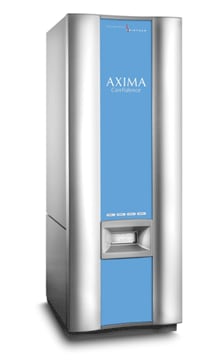
AXIMA Confidence


The analysis of proteins separated by 2D gel workflows by MALDI TOF MS has become routine over recent years. The protein sample is generally excised, destained and digested by trypsin prior to peptide mass fingerprinting. Often, a clean-up step is included,forexample,ZipTips® packedwithaC18 bed may be used to desalt the complex mixture of resultant peptides. 1D gel bands also contain a wealth of information and can be used to characterize a protein sample. The increased complexity of the sample, sometimes containing many different proteins, can complicate the analysis making it more difficult to identify proteins contained within the band. Often, only one or two proteins are identified when it is clear that many more proteins are present within the sample. This can be due to a number of factors, including ion suppression and competitive ionization when the sample is particularly complex. In addition, it is difficult for a database search to deconvolute the mixture of peptides and “pull out” the relevant protein identifications from MS data alone. Simple separation of the peptide pool prior to MALDI mass spectrometric analysis can greatly increase the number of proteins identified from 1D gel bands. This can be achieved quickly and economically using stepped elution from a ZipTip and requires no expertise or additional sample handling steps. The resultant peptides are analyzed by either seamless PSD (post source decay) or by MS/MS and their fragment ions subjected to a database search. Here, we present results obtained from a number of 1D gel bands from different sources demonstrating the increase in the number of proteins identified using this approach.
December 6, 2013 GMT