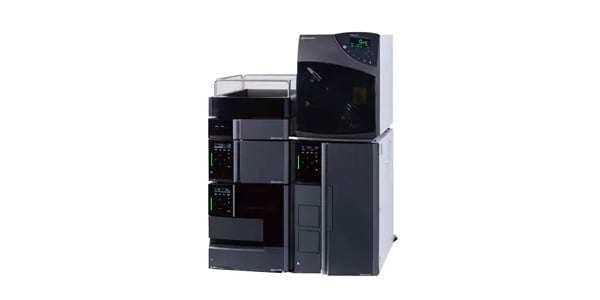
ELSD-LT III


Saccharides are mainly analyzed by ligand exchange chromatography or hydrophilic interaction chromatography. HILIC can be applied to oligosaccharides having larger retention as well as monosaccharides and disaccharides. The combination of HILIC and gradient elution provides simultaneous analysis of saccharides in relatively short time. Saccharides show very narrow UV absorption wavelength range, from 190 nm to 195 nm. Therefore, a refractive detector (RID) is commonly used for this analysis. However, gradient elution cannot be used with RID because the baseline drifting derived from the change of mobile phase composition during gradient elution is practically unacceptable. So, RID is not suitable for a simultaneous separation of compounds that show widely different retention behaviors due to expected long analysis time without gradient elution. Evaporative light scattering detector (ELSD) is one of universal detector that detects the scattering light from the target compounds after nebulizing and evaporating the mobile phase. ELSD provides reduced analysis time and simultaneous separation of compounds that show widely different retention due to applicability to gradient elution. The individual amounts of saccharides contained in foods are often grately different. Simultaneous analysis of such components requires different optimized sensitivity settings for individual compounds, and it is normally tedious procedures. “Wide function”, a new feature of ELSD-LT III used in this article, automatically optimizes a parameter that is related to sensitivity and a single method file can be used for data acquisition regardless of sample concentration, from low to high. Here, 10 kinds of maltoorigosaccharides (G1〜G10) in a soft drink were analyzed simultaneously by ELSD-LT III.
September 1, 2020 GMT