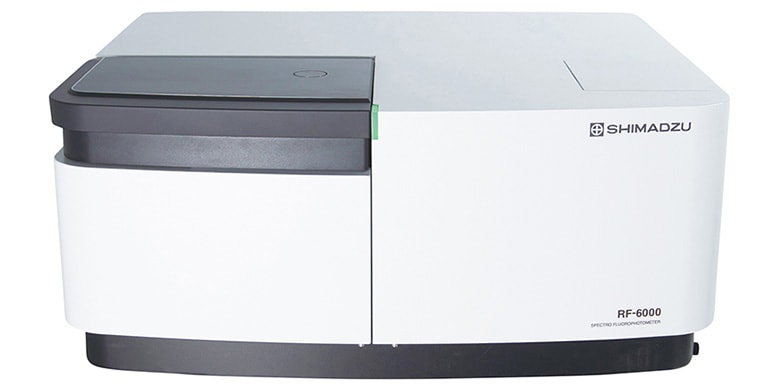
RF-6000


Spectrophotometric Analysis
Amyloid-β is a peptide that consists of approximately 40 amino acid residues. Amyloid fibrils (fibrous aggregates), which occur as a result of the formation of parallel β sheets by intermolecular association of amyloid-β, are the main component of the senile plaques (amyloid plaques) seen in the brains of Alzheimer’s disease patients. Moreover, the formation mechanism and structure of amyloid fibrils have attracted great interest, as amyloid fibrils are also implicated in other neurodegenerative diseases, including Parkinson’s disease. Fluorometric analysis using Thioflavin T (ThT), a fluorescent dye used as a marker for amyloid aggregation, is a suitable technique for evaluating amyloid-β aggregation. In this experiment, the formation process of amyloid fibrils was monitored by measuring the fluorescence intensity of ThT and the Rayleigh scattering intensity of the sample solutions, which is proportional to turbidity, at regular time intervals. Although ThT emits almost no fluorescence when it exists in a free state in a solution, it exhibits extremely strong fluorescence (excitation wavelength: 440 nm, fluorescence wavelength: 482 nm) upon binding with amyloid fibrils.
June 8, 2020 GMT