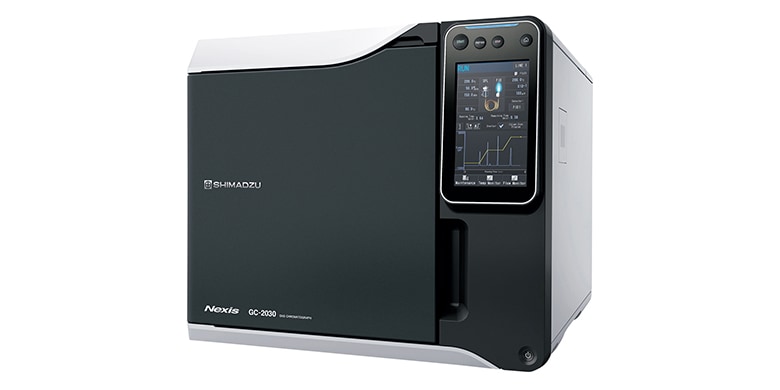
Nexis GC-2030


Gas Chromatography
Every day, worldwide, large quantities of crude oil are processed into various mineral oil products such as petrol, kerosene, diesel, heating oil, and lubricating oil. Mineral oil products are generally composed of mostly saturated hydrocarbons, so- called mineral oil hydrocarbons (MOH). During the production as well as the commercial and private use of mineral oil products, water and soil are repeatedly contaminated. Since mineral oil hydrocarbons are difficult to biodegrade, it is very important to control the contamination of environmental samples with MOHs. The analysis of mineral oil hydrocarbons in drinking water, surface water, and waste water is defined by the European standard EN ISO 9377-2, colloquially called H53. A water sample is extracted and then purified with Florisil to remove polar substances. The purified extract is analyzed by gas chromatography with flame ionization detection (GC-FID). It is not required to assign individual substances due to the complexity of the hydrocarbon mixtures. Quantification is therefore performed by integrating the total peak area between the marker substances n-decane (C10) and n-tetracontane (C40). Thus, the examined boiling point range is between 175 and 525 ºC. For determination of mineral oil concentration, a mineral oil mixture (diesel lubricating oil mixture, mineral oil type A and type B) is used as an external standard. Soil and sludge samples can be determined analogous to H53, as defined by the European standard ISO 16703:2011.
October 10, 2019 GMT