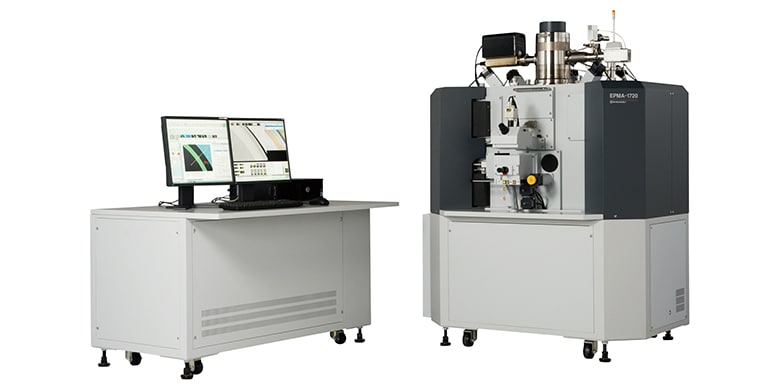
EPMA-1720


- Phase analysis by quantitative mapping of iron oxide scale and identification of the types of iron oxide by Fe-L line state analysis are possible. - Useful in research to improve the appearance quality of hot-rolled steel sheets. - Useful in research on phase transformation behavior and control of the adhesion of iron oxide scale.
In the hot-rolling process used in the manufacture of steel plates, wire rod material, and other steel products, an oxidized film (scale) with a thickness of approximately several mm forms on the steel surface because the material is heated to a high temperature of 800 to 1200 ˚C. This oxidized scale is removed by high pressure water or other methods before rolling, but if rolling is conducted without complete descaling, surface flaws will occur, causing a remarkable deterioration in the surface quality of the finished product. Moreover, because new oxidized scale with a thickness of several μm to several 10 μm is formed by reoxidation immediately before rolling, the product is either shipped as mill scale steel or is descaled by acid treatment (pickling). Because removal of the oxidized scale that forms on the surface of steel products has a large influence on the surface properties of the products, research and development have been conducted to clarify the relationship between the growth rate of oxidized scale and the surface properties, high temperature adhesion, and the peelability of the scale. This article introduces an example of an analysis of oxidized scale using an EPMA-1720HT EPMA™ electron probe microanalyzer.
February 28, 2021 GMT