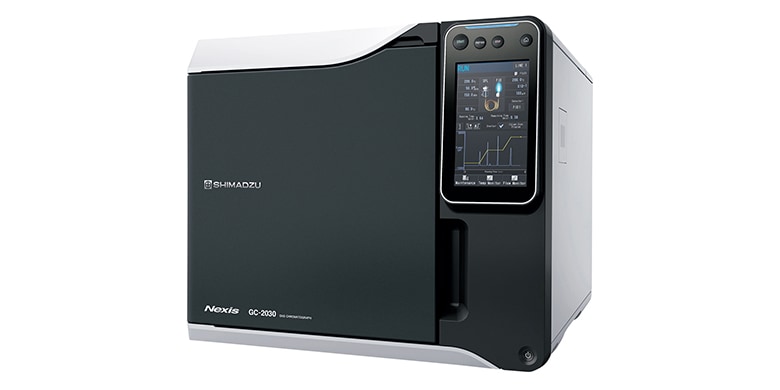
Nexis GC-2030


- Regarding the JIS T 0993 -7: 2012, the analysis conditions of residual ethylene oxide (EO) in medical devices were established by headspace gas analysis of solvent extract using water as an extraction solvent. - The use of water as an extraction solvent has made it possible to perform environmentally friendly, safe, and inexpensive analyses.
Ethylene oxide gas (EOG) is a flammable and colorless gas commonly used in medical device sterilization. Its permitted maximum residual levels are set by a range of international and local organizations, including the International Organization for Standardization (i.e., ISO 10993-7:2008) and Japanese Industrial Standards (i.e., JIS T 0993-7:2012). In these standards, extraction can be either exhaustive or simulated-use. The exhaustive extraction entails a solvent extraction using both gas chromatography (GC) and headspace (HS). The choice of extraction solvent depends on the sample and its intended use. The use of water as the extraction solvent is attracting attention as an environmentally friendly analysis. In this article, extraction of residual EO using water as extraction solvent by the HS-GC was performed in reference to the JIS and ISO section K.4.4 “Exhaustive Extraction with Ethanol Followed by Headspace Gas Analysis of the Ethanol Extract.”
June 15, 2023 GMT