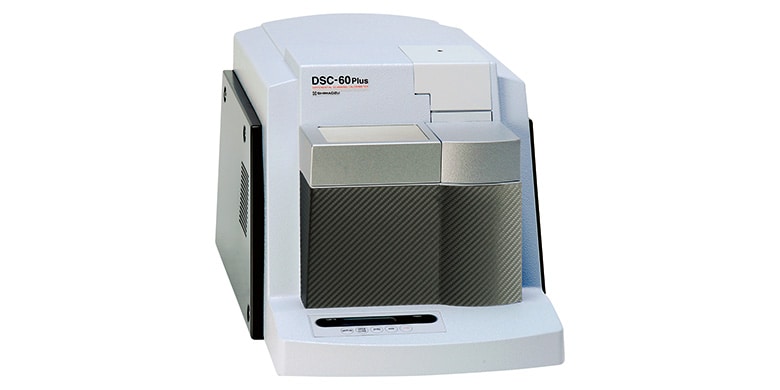
DSC-60 Plus Series


-� DSC is effective in the selection and setting of the molding conditions of diverse 3D printer filaments. �- Differences in thermal properties, even in filaments of the same resin, can be confirmed easily by DSC. �- DSC can grasp the effects of the thermal properties of the filament on the formability and physical properties of molded products.
3D printers, which are capable of constructing 3-dimensional molded objects, have been adopted widely not only in industrial applications but also for home use by hobbyists. The mainstream molding method in 3D printers is a technique called fused deposition modeling (FDM), in which a continuous resin filament is melted by heat and then deposited in layers. Filaments for 3D printers are made from thermoplastic resins, and various types have now been developed. Although the main filament materials are ABS resin and PLA resin, other materials include not only engineering plastics but also super engineering plastics and composites made by adding glass fiber or carbon fiber to a thermoplastic resin. Because 3D printers utilize the characteristic that the filament material softens when heated and then hardens when cooled, the differential scanning calorimeter (DSC), which enables detailed analysis of fusion and crystallization, is extremely effective in material selection and setting of the molding conditions. This article introduces an example in which the thermal properties of several composite filaments for 3D printers were measured with Shimadzu thermal analyzers.
April 30, 2021 GMT