
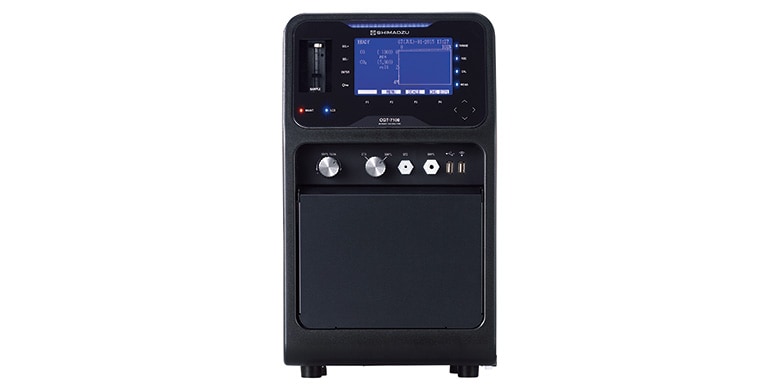
CGT-7100


- Non-dispersive infrared absorption spectrophotometry by ratio photometry achieves excellent measurement value stability. - Offers both the portability and simplicity essential for workplace measurements. - Acquired data can be stored on a USB flash drive for easy editing on a computer or sharing with other departments.
From the perspective of preventing infectious diseases, gas poisoning accidents, and improving the working environment, there has been rapidly growing interest in regularly exchanging the air in indoor spaces and vehicle interiors. Two methods are widely used to determine ventilation rates based on measuring CO2 as a tracer gas. The CO2 concentration decay method determines the exchange rate based on how much indoor CO2 concentration levels decrease over time due to ventilation measures, whereas the constant CO2 concentration method determines the ventilation rate based on the amount of CO2 that must be generated within a room to maintain a constant concentration. For this experiment, the CO2 concentration decay method was used with a glovebox as a model for simulating room air to demonstrate the utility of CGT-7100 transportable gas analyzers for measuring indoor ventilation rates. Given a starting CO2 concentration inside the glovebox that is higher than in the external air, when ventilation is started, the external air flowing into the glovebox dilutes CO2 to gradually decrease the concentration level. The CGT-7100 determines the ventilation rate by measuring that concentration change.
June 29, 2021 GMT