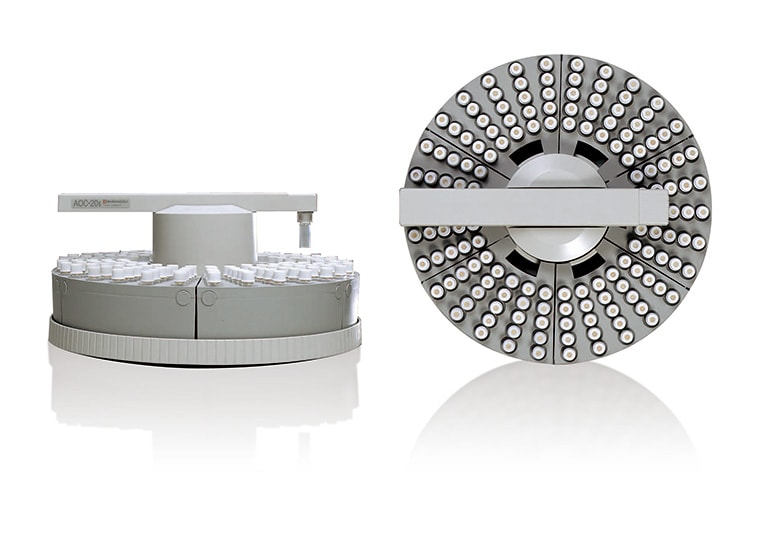
AOC-20i/AOC-20s


- The boiling range distribution of base oils and lubricating base stocks can be determined based on ASTM D7500. - LabSolutionsTM SIMDIS GC Software supports data acquisition, SIMDIS data processing, and report preparation. - The i-PeakFinder function makes it simpler to determine integration parameters to calculate peak skewness.
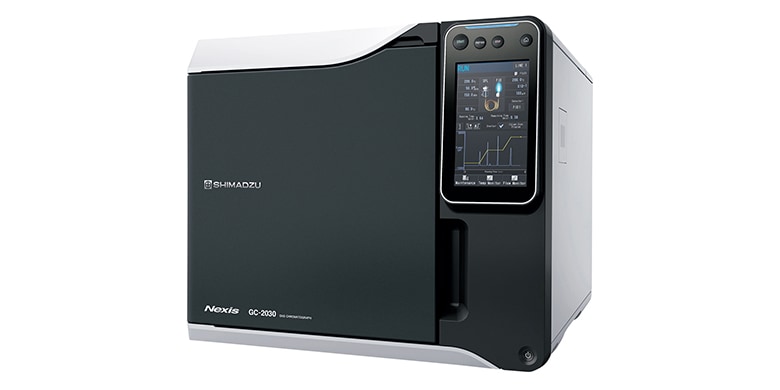
Petroleum products such as gasoline, diesel oil, lubricating oil, and asphalt are crucial to support our everyday lives. These materials are the complex of several hydrocarbons, and their properties vary depending on their composition. By investigating the distillation characteristics, it is possible to make more effective use of them, control quality, and determine pricing. ASTM D7500 is a standard test method for determining the boiling range distribution of petroleum products by simulated distillation using capillary gas chromatography and a flame ionization detector (FID). This applies to distillates with an initial boiling point (IBP) of 100 °C or higher and a final boiling point (FBP) of 735 °C (the boiling point of carbon 110) or lower, such as base oil and lubricating base stocks. The injected sample must elute completely from the gas chromatographic column, and the distillation curve is obtained using the total area of the sample chromatogram. In this article, we introduced an example of the analysis of lubricating oil based on ASTM D7500 with the new SHIMADZU OCI-2030 NX injection unit.
September 24, 2021 GMT