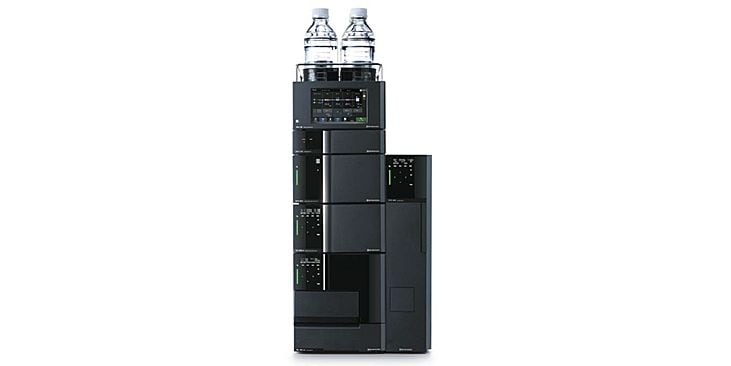
Nexera Series Ultra High Performance Liquid Chromatograph


- The results of system suitability test meet all criteria of system performance and reproducibility described in the Japanese Pharmacopoeia 17th Edition Voglibose Tablets Assay. - A cooling chamber is not required because the cell temperature of the fluorescence detector can be controlled to 15 ̊C. - Whole system including the chemical reaction box meets data integrity requirements.
Voglibose is known as one of the antidiabetic drugs. It can delay the digestion and absorption of sugars and improve post- prandial blood glucose levels by inhibiting the activity of α- glucosidase, which is responsible for the decomposition of disaccharides to monosaccharides, in the intestinal tract. Since voglibose does not have UV absorption, the Japanese Pharmacopoeia (JP) 17th Edition describes the monographs (purity test for voglibose, assay for voglibose tablets) using the HPLC post-column fluorescence derivatization method with a taurine/sodium periodate reagent. This article introduces an analysis complying with the assay method for voglibose tablets described in the JP 17th Edition, using the Nexera series HPLC.
February 3, 2022 GMT
Some products may be updated to newer models