
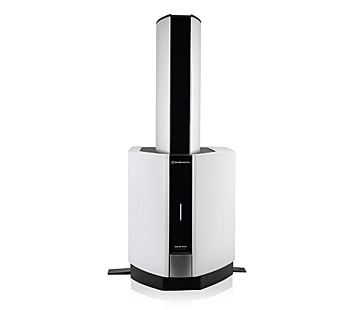
MALDI-8030


- Higher number of samples on the target increases the throughput. - Higher sensitivity. - Less sample (volume) needed.
Miniaturization, parallelization, and automation are crucial for modern approaches in drug discovery and biotechnology in order to maximize the throughput, efficiency, and reducing the massive expenses. Aquarray developed a Droplet Microarray (DMA) technology for chemical synthesis, characterization and biological screening. The surface of a target slide / plate is chemically modified and omniphilic-omniphobic patterned resulting in a high contrast in wettability between omniphilic spots and surrounding omniphobic areas. Thus, aqueous and organic liquids can be applied manually by a pipette or automated using a liquid dispenser on the patterned surface while generating high-density arrays of nanodroplets. Each nanodroplet represents a separated vessel that can be used for different chemical, analytical or biological experiments. One of the critical steps in the workflow of combining chemistry with biology is the analytical investigation, since most analytical techniques are not designed for a highly miniaturized setup. Shimadzu MALDI mass spectrometers enable fast and sensitive characterization of chemical and biological samples. Here we report a high-throughput workflow using the Aquarray droplet microarray technology for fast sample preparation and high- sensitivity MALDI MS characterization down to the attomole range per spot.
February 3, 2022 GMT