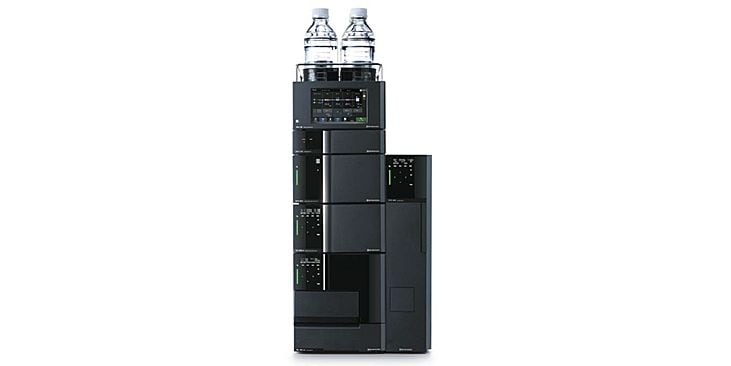
Nexera Series Ultra High Performance Liquid Chromatograph


- NexeraTM can analyze abietic acid with a high sensitivity, good consistency, and highly accurate results. - It is possible to evaluate drug quality by the similarity of UV spectra.
A method of testing for abietic acid and determining its UV spectrum in prepared Chinese medicines using high- performance liquid chromatograph Nexera series was devised based on supplementary methods of testing for abietic acid (BJY 201908, BJY 201909, BJY 201919, BJY 202004, and BJY 202005) issued by the National Medical Products Administration. Results of an experiment revealed that the theoretical plate number calculated based on the peak for abietic acid was in accordance with the supplementary methods of testing for abietic acid. Abietic acid was not detected in any of the following prepared Chinese medicines: Nujin pills, Jiebai capsules, Chenxiang Huazhi pills, Fengshi Ershiwuwei pills, or Shensanqi Shangyao capsules. Nexera is an entirely new generation of high- performance liquid chromatograph with a high sensitivity, good consistency, and highly accurate results, and is suitable for tasks related to drug quality control in the pharmaceutical industry and industries involving drug testing. Abietic acid is a hard and brittle glassy solid with an odor of pine resin. It has an extremely wide range of applications and is used in fields such as rubber, plastics, paints, paper- making, surfactants, pharmaceuticals, electrical devices, and building materials. In adhesives, it is mainly used as a tackifier. A mixture of rosin dust and air is explosive. Abietic acid has limited toxicity but its concentrated vapor can cause symptoms of acute poisoning such as headaches, dizziness, coughing, and asthma. The National Medical Products Administration has issued a number of bulletins on supplementary methods of testing for abietic acid (BJY 201908, BJY 201909, BJY 201919, BJY 202004, and BJY 202005) that specify methods of testing for abietic acid in relevant prepared Chinese medicines. Liquid chromatography is used to qualitatively determine its retention time and photodiode array (PDA) spectral information in prepared Chinese medicines. Based on the supplementary methods of testing for abietic acid mentioned above, a method of using a liquid chromatograph equipped with photodiode array detector to test for abietic acid improperly used in five traditional Chinese medicines was devised. This method integrates chromatographic separation and qualitative aspects of UV spectra, offers a high selectivity and sensitivity, and can provide a reference for related industries.
April 5, 2022 GMT
Some products may be updated to newer models