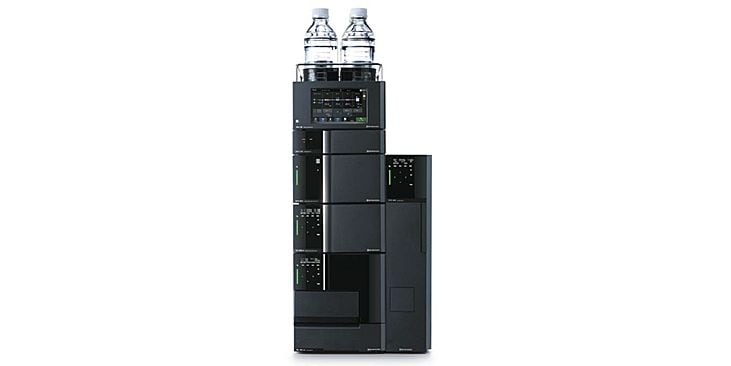
Nexera Series Ultra High Performance Liquid Chromatograph


- Separation of co-eluting component without changing analytical conditions by using i-PDeAII - Higher selectivity and sensitivity can be obtained by using a fluorescence detector.
ADRA, as a skin sensitization test, that evaluates the allergic reaction of chemicals to the skin using N- (2- (1-naphthyl) acetyl) -L-cysteine (NAC) and α-N- (2- (1-naphthyl) acetyl) -L-lysine (NAL) which contains naphthalene rings and cysteine or lysine. An example analysis according to the OECD Test Guideline is given in AN _ 01-00258. Depending on the test substance, co- elution peaks may appear near the NAC and the NAL peaks. In this case, LC separation conditions should be considered. The ADRA test must be performed within 72 hours from sample preparation. If the co-elution peak appears, the test must be repeated from the beginning. In this report, we introduce two methods to avoid the interferences of co-elution peaks by increasing the selectivity of detection without changing the analysis. One example is the use of a fluorescence detector (RF), which is more selective than a UV detector, to avoid the interferences of co-elution. Another example is an analysis using a photodiode array detector (PDA) with the deconvolution function i-PDeA II to obtain separated peaks.
September 29, 2022 GMT
Some products may be updated to newer models