
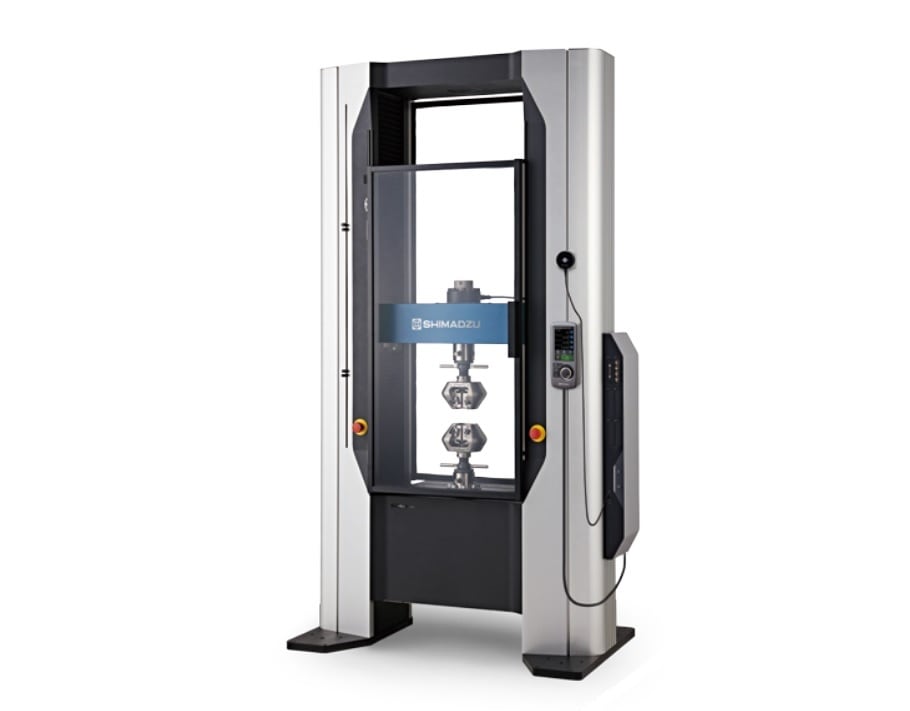
AUTOGRAPH AGX™-V2 Series


- Tensile testing of metallic materials conforming to JIS Z2241 is possible by using the AGX-V and TRViewX. - Visualization of the strain distribution during tests is possible by using Real-Time Strain ViewTM. - The region where mechanical properties are improved by radial forging processing can be estimated by conducting a static tension test.
The trend toward decarbonization for reduction of greenhouse gas (GHG) emissions has accelerated in recent years, and as part of those efforts, the shift to electric vehicles (EVs) in the automobile industry will play a large role in the realization of a decarbonized society. Since extending the cruising range of EVs is a key requirement for popularizing electric vehicles, vehicle weight reduction for this purpose has been taken up as a development theme. Among candidate parts, reduction of the weight of motor shafts is a particularly important issue for development, since it will not simply increase the cruising range of EVs, but is also expected to improve motor responsiveness by reducing inertial force. Radial forging is a new forging technology for hollow shafts, and makes it possible to form the inner and outer diameters simultaneously by applying force to the hollow shaft or the hollow axis in the radial direction with a hammer (die) while inserting a core bar to transcribe the inner diameter shape. Since hollow shafts manufactured by radial forging can satisfy both strength and weight reduction, this technology has attracted considerable interest as a next-generation shaft manufacturing method. In forging processes such as radial forging, the product is formed to the target shape while also increasing its strength by refinement of the crystal grain structure by deformation of the metal surface by hammering (i.e., forging). For this reason, it is important to identify the region which is affected by the forging process, that is, how far the effect of forging extends from the surface layer into interior of the material. This article introduces an example in which samples were actually cut from a radial forging, and differences in their mechanical properties depending on the position were assessed from the surface layer to the interior.
January 31, 2023 GMT