
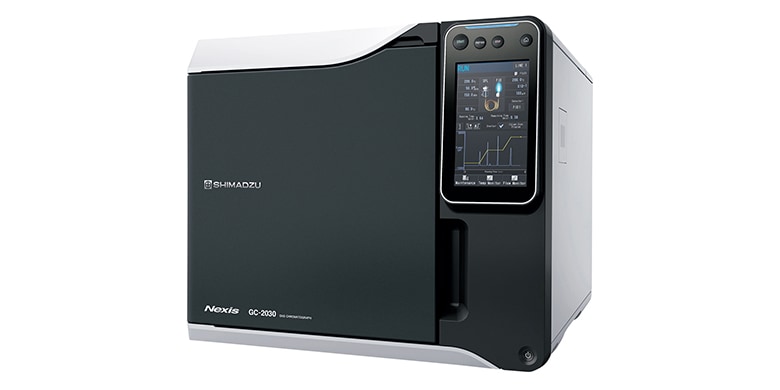
Nexis GC-2030


- The distillation characteristics of fuels with boiling points from 55.8 to 538 °C can be investigated by accelerated analysis in accordance with ASTM D2887 Procedure B. - Procedure B enables the measurement of biodiesel blends, such as B5, B10, and B20. - LabSolutionsTM simulated distillation GC software allows centralized management of data acquisition, distillation GC analysis, and report creation.
Naphtha, gasoline, diesel, and other petroleum products derived from fossil fuels are used in different ways depending on the distribution of boiling points in their composition. In recent years, there has been a growth in petroleum product alternatives utilizing renewable energy sources such as biomass. The distillation method is typically used to measure the distribution of boiling points of components in such fuels. However, in the laboratory, the distillation method can require tedious and complicated operations, so methods that use gas chromatography to simulate the distillation method have been widely adopted. ASTM D2887 is a test method that simulates the distillation method using capillary gas chromatography to analyze the distillation characteristics of fuels with boiling points ranging from 55.5 to 538 °C. Furthermore, Procedure B specifies analytical conditions that accelerate distillation analysis and can also be used to analyze biodiesel blends such as B5, B10, and B20. This article describes an example of using the accelerated ASTM D2887 Procedure B to investigate the distillation characteristics of a biodiesel mixture.
March 28, 2023 GMT