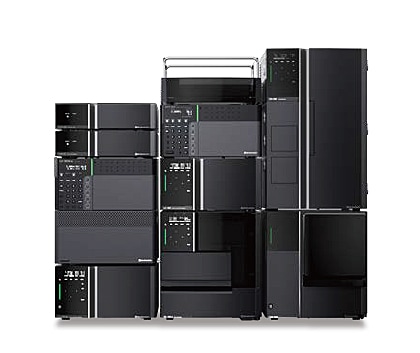
Nexera UC


Supercritical fluid chromatography (SFC) has been considered difficult to apply to oligonucleotides, which are highly polar compounds, due to the polarity of carbon dioxide used as the mobile phase. However, a previous study found that 4-mer DNA was able to be applied to SFC. In this study, the applicability of SFC to oligonucleotide longer than 4-mer was investigated. In addition, to evaluate the separation behavior of SFC, we applied it to the separation of deaminated oligonucleotides, which are difficult to separate even by the existing ion-pair reversed-phase chromatography (IP-RPLC). Assuming that SFC would be applied to the purification of oligonucleotides after synthesis, sequences with and without dimethoxytrityl (DMTr) protecting group were employed as samples. Using optimized modifier containing octylamine, 18-mer modified oligonucleotides were detected. As a result of optimization of analytical conditions for the separation of deaminated oligonucleotides, 10- and 18-mer target oligonucleotides and their deaminated products were able to be separated. This article has been re-written based on the original paper published in Journal of Chromatography A (Open Access version).
May 22, 2025 GMT
This application relates to an invention for which a patent application is pending.