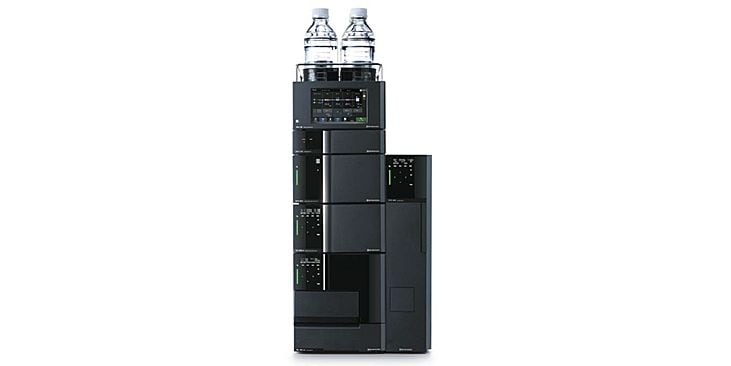
Nexera Series Ultra High Performance Liquid Chromatograph


- This method can accurately quantify the sample in just 8 minutes, which is more efficient than the FDA method. - The linear minimum concentration is 0.2 ng/mL, which is lower than the nonbinding recommendations of 1 ng/mL by the FDA, indicating greater sensitivity.
Bumetanide is a derivative of melamine benzene sulfonamide and is a potent diuretic. It is widely used in the treatment of edema associated with heart failure, liver disease, and kidney disease. It is mainly used for various refractory edemas and acute pulmonary edema. It is particularly suitable for patients with acute and chronic renal failure. Because its structure contains a secondary amine group, it provides an amino unit for the formation of nitrosamines. In the production process, so-called NDSRI (nitroso drug substance-related impurities) and nitrosated bumetanide are produced. These impurities pose a risk of carcinogenicity or mutagenicity and have led to the recall of multiple medications. FDA has quantified it in its guidance for nitroso bumetanide impurities using high-resolution mass spectrometry, with a method detection limit (LOD) = 0.5 ppm. Quantitation limit (LOQ) = 1.0 ppm. This article uses the LCMS-8045RX to establish a detection method for Nitroso Bumetanide in Bumetanide. After methodological validation, the results show that the analytical method can accurately and rapidly determine the amount of nitrosated bumetanide in the API, which can be used for reference by relevant testing personnel.
July 15, 2025 GMT
Some products may be updated to newer models