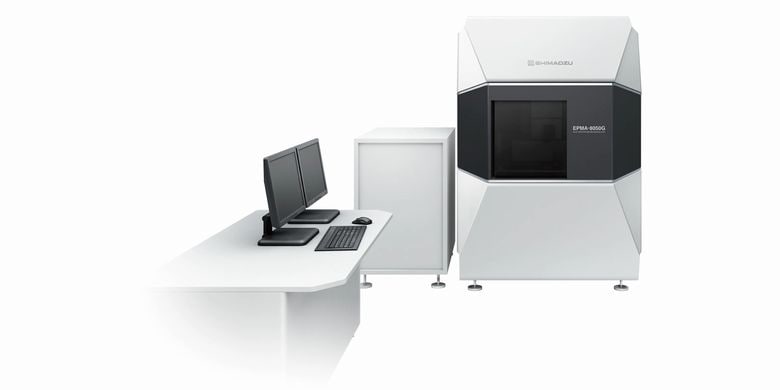
EPMA-8050G


- Useful in evaluation of the particle shape of silver sintering die attach materials. - Useful in evaluation of the sintered condition, such as voids, and the diffusion of elements at the bonding interface in silver sintering. - Useful in research on surface properties, such as the film thickness in metalizing treatment.
Power semiconductors are used in a wide range of applications, from household electrical appliances and automotive devices to power transmission and distribution systems. Recently, SiC (silicon carbide) semiconductors, which allow high-temperature operation, have attracted attention as a substitute for conventional Si (silicon) semiconductors. With application of SiC, the operating temperature of power semiconductors is expected to increase to 200 ˚C or more in the future. However, in this case, the heat resistance of the die bond where semiconductor chips are bonded to a substrate becomes an issue, as high-temperature operation may cause deterioration or embrittlement of the joining material. Silver (Ag) sintering materials can withstand high temperatures exceeding 200 ˚C and have excellent thermal conductivity, enhancing heat dissipation and realizing improved temperature management of devices. Since embrittlement can be preventing by using Ag sintering materials, thereby improving the reliability of the bonds, Ag particles have attracted interest as a die bond material with excellent heat dissipation. This Application News article introduces an example of analysis of a power semiconductor using an EPMA electron probe microanalyzer (EPMA-8050G).
September 17, 2025 GMT