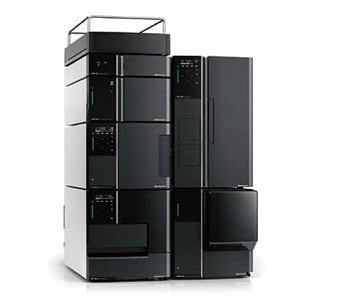
LCMS-2050


- Combination use of LCMS-2050 single quadrupole mass spectrometer and LabSolutions Insight Biologics provides comprehensive characterization of oligonucleotides and related impurities. - Purity calculations for target components can be performed even on poorly separated peaks by utilizing MS spectra simultaneously acquired with UV chromatogram.
In recent years, oligonucleotide therapeutics have been paid attention as a novel drug discovery modality because of their rapid progress of development. During the synthesis of oligonucleotide therapeutics, impurities that have differing base chain lengths are generated along with the target oligonucleotide. To ensure the safety and efficacy of the drug, comprehensive detection and identification of these impurities are required. Reversed phase ion-pair chromatography is often employed as a method to separate the target compound from co-existing impurities. However, it is often difficult to establish analytical conditions that provide compete separation of all impurities that are formed in synthesis process due to their similar structures and properties to the principal compound of active ingredient. Against this drawback, liquid chromatography-mass spectrometry (LC-MS) is commonly used for impurity detection and identification. For analysis of oligonucleotide impurities, quadrupole time-of-flight mass spectrometers are mainly used because of their high mass resolution and ability to perform sequence and structure estimations via MS/MS analysis. However, in quality control process, the use of a single quadrupole mass spectrometer is expected to be advantageous because of providing mass information with easy operation when impurity information is already known. This article presents a simulated impurity analysis of synthetic oligonucleotide using the LCMS-2050 high-performance liquid chromatography-mass spectrometer and LabSolutions Insight Biologics.
November 4, 2025 GMT
Some products may be updated to newer models