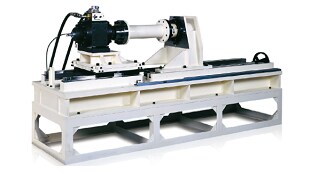
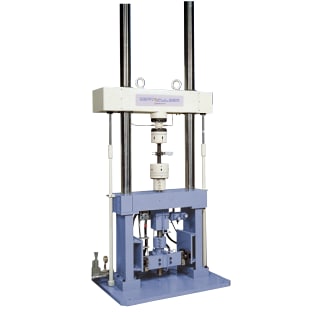
Axial Force and Torsion Testing Machine


- Dynamic characteristic tests based on JIS K6385 can be performed. - Frequency sweep tests automatically measure dynamic characteristic values at each frequency. - Tests in both torsional and pinching directions can be performed simply by changing the jig.
Rubber vibration isolators are a product designed to prevent or mitigate the transmission of vibration and shock and are widely used in various fields such as transportation equipment, construction, and industrial machinery. JIS K6385 “Rubber vibration isolators - Testing methods” specifies several test methods and terms for evaluating the performance of rubber vibration isolators. Among these, tests in the torsional direction around the central axis and tests in the torsional direction around an arbitrary axis perpendicular to the central axis (pinching test) are defined for cylindrical rubber vibration isolators. Cylindrical rubber vibration isolators are used for supporting and coupling vibration sources such as engines and motors, and play an important role in reducing noise and stabilizing performance. When mounted on a vehicle, loads are applied in both the torsional and pinching directions, so it is necessary to evaluate the characteristics of each. This article introduces examples of dynamic characteristic tests in the torsional and pinching directions for cylindrical rubber vibration isolators. International standards corresponding to JIS K6385 have not been established at present.
November 4, 2025 GMT
Some products may be updated to newer models