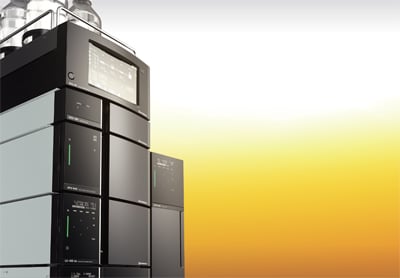
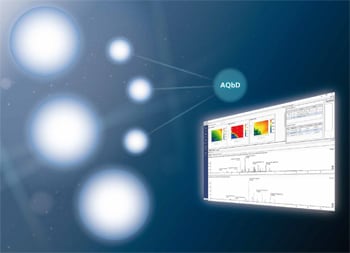
Method Development System


- Sample dilution can be automated using the automatic pretreatment function “co-injection” for purified fractions of oligonucleotides containing high concentrations of salts. - The automatic pretreatment function “co-injection” enables the simultaneous injection of a sample and a selected co-injection solvent. The co-injection solvent and its injection volume can be easily set via LabSolutions MD interface.
In HPLC analysis, the composition of the sample solvent is critical for achieving proper peak shape. If the sample solvent is a stronger eluting solvent than the mobile phase, sample band condensation at the column inlet may be insufficient, leading to sample band broadening. For instance, increasing the organic solvent ratio in the sample solvent to dissolve low-polar compounds may deteriorate the peak shapes of early-eluting compounds in reversed-phase chromatography. Oligonucleotides are synthesized using the phosphoramidite method and subsequently purified by anion exchange chromatography or reversed-phase ion-pair chromatography (RP-IP). Purified fractions from anion exchange chromatography often contain high concentrations of salts, such as sodium chloride (NaCl) and sodium bromide (NaBr). When these purified fractions are analyzed using RP-IP, the high salt concentration in the sample solvent may interfere with the ion-pair formation capacity of the oligonucleotides. This interference can result in improper peak retention and adversely affect the chromatogram. This article introduces a case study demonstrating an improvement in oligonucleotide peak shape by suppressing the sample solvent effect through simultaneous injection with a desired solvent. This automatic pretreatment function “co-injection” is a standard feature included in the autosamplers of Nexera series. Furthermore, by utilizing LabSolutions MD, a dedicated software for supporting method development, comprehensive evaluation of co-injection solvent types and co-injection volumes was efficiently performed.
November 18, 2025 GMT
This application relates to an invention for which a patent application is pending.
Some products may be updated to newer models