
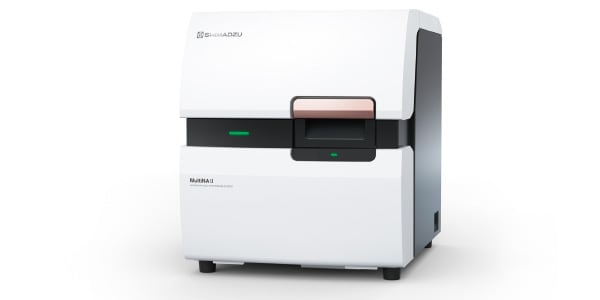
MultiNA II MCE-301, Microchip Electrophoresis System for DNA/RNA Analysis


- The electrophoresis operation can be performed almost fully automatically. - Heteroduplex can be detected by differences in mobility. - Mutations and deletions in multiple genome-edited samples can be efficiently screened.
The advent of genome editing tools has made it possible to specifically disrupt or insert target genes into target genomic regions. Genome editing technology is rapidly gaining popularity because it can now be easily applied to microorganisms, animals, plants, and other organisms that have been difficult to genetically modify in the past. There are two methods for evaluating the presence of mutations at the target site: direct sequence analysis and the use of enzymes that recognize and cleave mismatches in the double strand, both of which are costly and labor-intensive. HMA (Homoduplex Mobility Assay) is a simple, rapid, and inexpensive method. In conventional electrophoresis, DNA is fully complementary homoduplex, and its mobility depends on its size (molecular weight). On the other hand, DNA that has a mutation in one part of one of the two strands is heteroduplex DNA, where the mismatch part does not form a complementary strand. The mismatch portion of heteroduplex DNA has a different three-dimensional structure than that of homoduplex DNA. HMA can use this phenomenon to determine the presence or absence of mutations and genotypes by electrophoresis. In this application, we present an example of HMA with model DNA using the MultiNA II MCE-301 microchip electrophoresis system.
January 27, 2026 GMT
Some products may be updated to newer models