
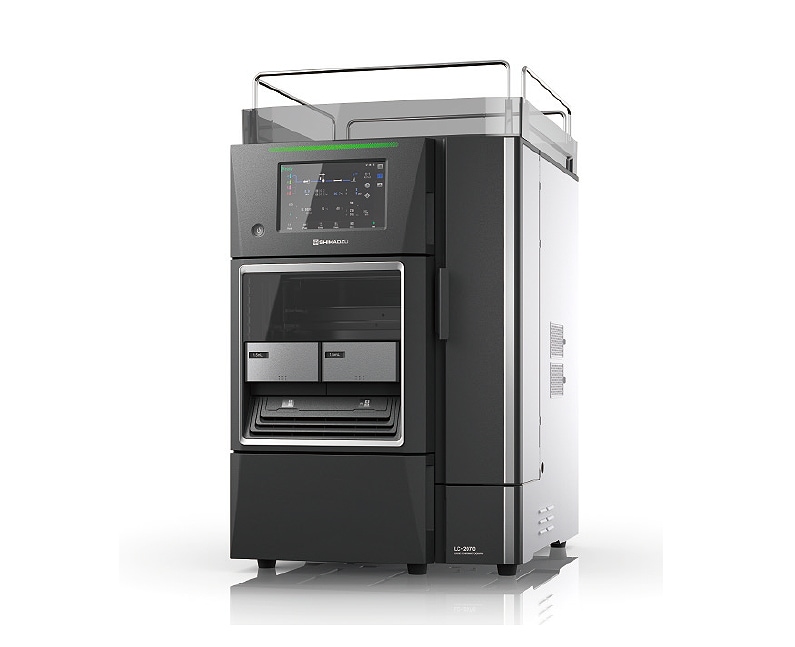
i-Series


- The anti-degradant additive 6PPD and its transformation product 6PPD-quinone can be analyzed simultaneously using an integrated HPLC system. - The detection limits for 6PPD and 6PPD-quinone with this method are sufficiently low, enabling high-sensitivity detection and quantitative analysis. - The pretreatment is very simple, making this method suitable for screening samples.
Rubber products, especially tire rubber, contain various anti-degradant additives to prevent degradation by oxidation and ozone and to improve durability. 6PPD (N-(1,3-dimethylbutyl)-N'-phenyl-p-phenylenediamine) is one of the most important additives used to protect against oxidative and ozone-induced degradation. Tires readily develop cracks when exposed to oxygen and ozone, but 6PPD inhibits that degradation, helping to prolong tire lifespan. However, when the tire wears, particles containing 6PPD may be emitted to the environment. 6PPD can react with ozone in the atmosphere to form a highly toxic substance called 6PPD-quinone (N-(1,3-dimethylbutyl)-N'-phenyl-p-phenylenediamine-quinone). 6PPD-quinone has been reported to be highly toxic to living organisms and has been shown to cause acute mortality in salmonid fish, specifically coho salmon. Currently, there is no commercial alternative that can maintain tire stability and performance with minimal impact on the environment. Research into alternatives requires accurately assessing 6PPD levels in rubber products and objectively determining whether alternative compounds offer equivalent stability and performance while having a reduced impact on the environment. This Application News article describes an example of analyzing the anti-degradant additive 6PPD and its transformation product 6PPD-quinone in tire rubber using an integrated HPLC system.
March 2, 2026 GMT