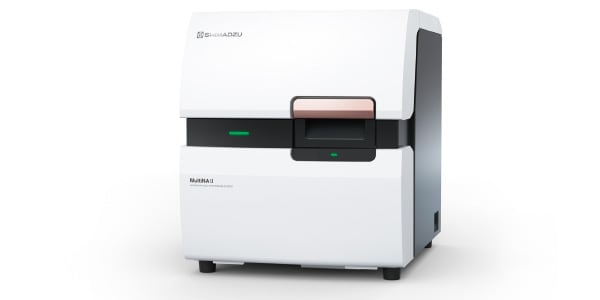
MultiNA II MCE-301, Microchip Electrophoresis System for DNA/RNA Analysis


- Since the electrophoresis operation is fully automated, the processes from sample preparation to detection can be largely simplified. - High analytical performance and reproducibility are achieved by selecting the optimal separation buffer and internal maker for each sample. - Fingerprinting analysis enables automatic judgment of the presence of DNA fragments in samples.
For seafood distributed in Japan, a quality labeling standard system has been established under the Act on Japanese Agricultural Standards (Act on Standardization and Proper Quality Labeling of Agricultural and Forestry Products), which requires accurate display of items such as the food product name and place of origin. Although the Japanese consume large amounts of fish belonging to the genus Thunnus (tuna), it is difficult to identify the various varieties of tuna from the external appearance in the fresh or processed condition. For this reason, misidentification, inaccurate labeling, and misrepresentation of the fish type in the distribution process have taken up social problems, requiring a quick, simple and accurate technology for distinguishing fish varieties. This article introduces an example of identification of the tuna varieties of Atlantic bluefin tuna (Thunnus thynnus), southern bluefin tuna (T. maccoyii ), α-type and β-type bigeye tuna (T. obesus), yellowfin tuna (T. albacares), and albacore tuna (T. alalunga) using the PCR-RFLP (Polymerase Chain Reaction-Restriction Fragment Length Polymorphism) method established by Japan's Food and Agricultural Materials Inspection Center (FAMIC). In this article, a MultiNA II MCE-301 microchip electrophoresis system was employed to detect the separation patterns of the PCR-RFLP products used to distinguish the fish varieties.
February 27, 2026 GMT
Some products may be updated to newer models