GCMS-QP2020 NX


- The deconvolution analysis feature in LabSolutions Insight Explore GCMS automatically detects and characterizes the peaks of trace amounts of compounds that are related to vulcanizing accelerators and other additives in tire rubber. - The Polymer Additives Library Ver. 2 enables easy identification of the peaks of these additives.
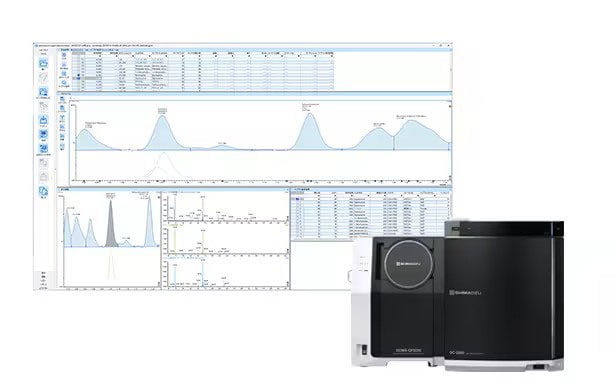
Vulcanizing accelerators are important additives used to improve wear resistance and other properties in tire rubber, so research and development of tire rubber requires analytical methods that provide detailed and accurate analysis of these compounds. Pyrolysis gas chromatograph mass spectrometer (Py-GC-MS), a commonly used technique that requires minimal sample pretreatment to analyze these vulcanizing accelerators, can detect and characterize both the vulcanizing accelerators and the compounds that are generated from the pyrolysis. (In this article, these compounds are referred to as “vulcanizing accelerator-related compounds.”) However, the following two issues can prevent the detection and characterization of these compounds. 1. Py-GC-MS directly analyzes tire rubber samples with minimal pretreatment, and it produces a complex chromatogram due to the co-elution of a wide range of impurities, including various additives and other compounds generated by degradation of the base tire material. 2. Vulcanizing accelerators are altered chemically or consumed during tire rubber production due to the role they play in the vulcanization process. Any vulcanizing accelerator-related compounds that remain in the rubber after these chemical changes may only be present in very small amounts, making their detection difficult. Deconvolution analysis is for detecting the peaks of trace-level components in chromatograms that also show numerous impurities. This article describes using LabSolutions Insight Explore GCMS software, which offers simple tools for deconvolution analysis, and Py-GC-MS to determine vulcanizing accelerator-related compounds and other additives in tire rubber.
April 15, 2026 GMT
Some products may be updated to newer models