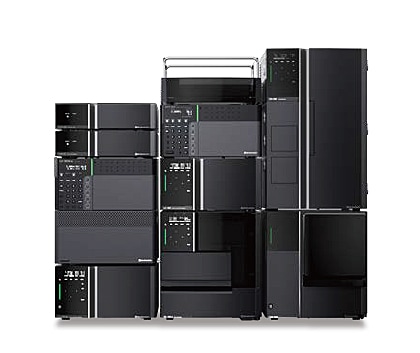
Nexera UC


- SFC enables high flow rate operation at lower column back pressure than LC, resulting in shorter analysis time and improved throughput in preparative purification. - Because the supercritical carbon dioxide rapidly evaporates during fraction collection, the labor required for post-purification drying and powderization can be greatly reduced. - Optimization of separation conditions can be streamlined by LabSolutions MD.
Supercritical Fluid Chromatography (SFC) is a separation technique that uses supercritical carbon dioxide as the primary mobile phase. Owing to its high diffusion coefficient and low viscosity, it enables high flow-rate delivery at lower column backpressure than liquid chromatography (LC), allowing shorter analysis time. Preparative LC is widely used in pharmaceuticals, food, and chemical industries for purifying target compounds, and SFC can also be applied to preparative purification. In preparative LC, post-treatment such as solvent evaporation and concentration is typically required after fraction collection. In contrast, in preparative SFC the supercritical carbon dioxide used as the mobile phase readily evaporates under ambient conditions, significantly reducing the effort required for concentration processes. To recover target compounds with high purity, separation conditions that adequately resolve them from other components and impurities must be established. Because preparative conditions consume large amounts of sample and mobile phase, separation conditions are typically optimized at the analytical scale before scale-up for fractionation. This article presents an example of applying SFC to a seamless preparative purification workflow. In addition, LabSolutions MD, a dedicated software for supporting method development, is used for efficient optimization of separation conditions.
August 17, 2026 GMT