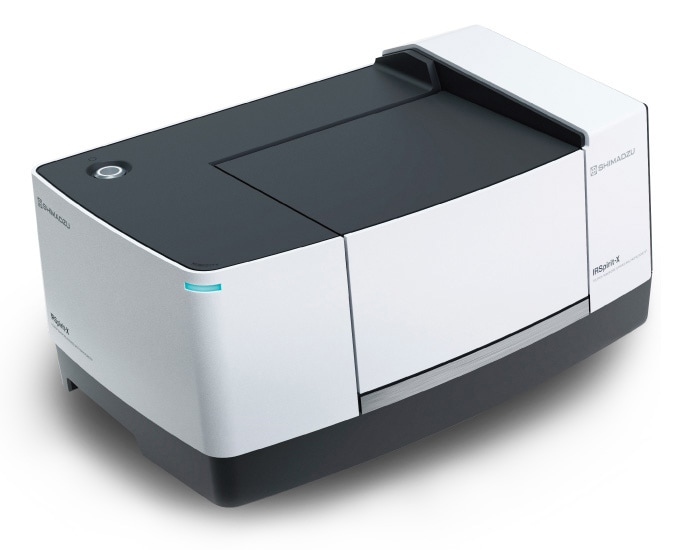
IRSpirit-X Series


- Plastics (including MPs) can be easily identified by measuring them using an FTIR spectrophotometer and searching spectral libraries. - Plastics can be identified with higher accuracy by comparing the library search results with the summary of wavenumbers for major peaks of typical plastics. - Additionally using the Library for UV-Degraded Plastics for library searches can be expected to improve the accuracy of identifying plastics (including MPs) in the environment.
The material characteristics of plastics in the environment must be confirmed before they can be used for research, recycling, or other applications. The material characteristics of plastics can be confirmed nondestructively and quickly using Fourier transform infrared (FTIR) spectrophotometry, which measures the vibrational modes originating from molecular functional groups of materials as peaks in infrared spectra. Then the material can be identified by comparing the multiple measured vibrational modes with spectra in a database (spectral library) in software, where identification involves narrowing down the similar candidate substances using indices, such as similarity score, hit quality, and HQI (high quality index) values, with the final decision made by a human. Therefore, by memorizing the major peaks of typical plastics, substances can be identified with higher accuracy. For information about the attribution of peaks, refer to FTIR Talk Letter vol. 42 to 46. This article describes the results from measuring the infrared spectra of typical plastics before and after UV degradation and comparing the peak wavenumber information for major peaks with other literature.
August 20, 2026 GMT
Some products may be updated to newer models