
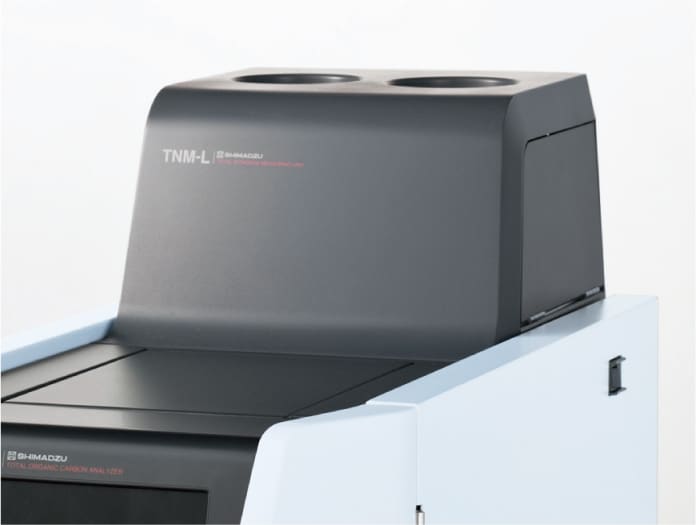
TNM-L


Total Organic Carbon Analysis
Diesel engines have mainly been used in large-sized trucks and buses, but advances in technology have enabled its use in passenger cars as well. Diesel engines feature good fuel efficiency (combustion efficiency), low carbon dioxide emissions, and great durability. However, there are also drawbacks such as the occurrence of noise and vibrations, and higher emissions of black smoke, particulate matter (PM), and nitrogen oxides (NOx). The PM and NOx contained in the exhaust of diesel engines are considered to be causes of atmosphere pollution, and technologies for preventing release such harmful substances into the atmosphere have been developed. A urea selective catalytic reduction (SCR) system can reduce atmosphere pollution by converting NOx into nitrogen and water. This system uses urea adjusted to an optimum concentration in order to efficiently convert emitted NOx. However, if the urea concentration is low, conversion of NOx may be insufficient. On the other hand, if the concentration is too high, an ammonia slip may occur, resulting in the leak of harmful ammonia outside of the system. Shimadzu's combustion method total organic carbon analyzers (TOC-L: laboratory analyzer; TOC-4200: on-line analyzer) can be combined with a total nitrogen (TN) measurement option to easily measure TN. If using the Kjeldahl method, which is widely used to measure nitrogen content, multiple reagents such as acids and alkalis are required and the measurement takes several hours for digestion and distillation. On the other hand, the TN measurement conducted with these analyzers is thermal-decomposition - chemiluminescence method. Therefore, reagents are not necessary and a measurement result can be obtained rapidly in approxi. 5 minutes. This article introduces example measurements of aqueous urea solutions (urea solution) adjusted to constant concentrations using a system comprising Shimadzu's TOC-L and TNM-L total nitrogen unit.
March 23, 2018 GMT