
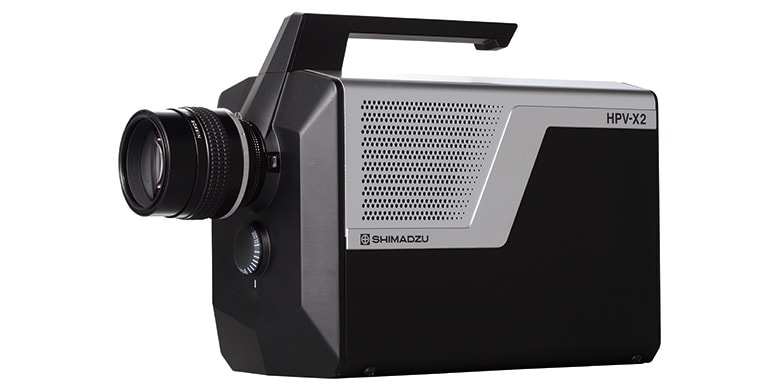
Hyper Vision HPV-X2


High-Speed Video Camera
Carbon fiber reinforced plastic (CFRP) is a composite material with a particularly high specific strength. It is used in aircraft and in some transport equipment to reduce fuel costs by reducing weight. While it has some excellent mechanical characteristics as a composite material, when in-plane damage occurs it displays brittle failure behavior, with fracture propagating instantly from the point of damage. Consequently, CFRP development involves not only material testing, but also observation of material failure to check for fracture locations at weak points. Furthermore, material failure is observed to evaluate the validity of computer aided engineering (CAE) recently. As mentioned above, a CFRP fracture event occurs extremely quickly and cannot be observed by the naked eye, so a high-speed video camera is used. Shimadzu has published an Application News on this topic in the past (No. V017 Observing the Failure of CFRP Materials in High-Speed Tensile Tests). High-speed tensile testing involves an instantaneous testing time. To accommodate this, a strobe capable of emitting very intense light instantaneously is used to achieve an image capture speed of over 1 million frames/second. Meanwhile, static testing involves longer testing times with a metal halide lamp used as a light source for continuous lighting (a relatively weak light source compared to a strobe), which cannot produce enough light to capture images at more than 500 thousand frames/second. The newly developed HPV-X2 camera is 6 times more sensitive than the previous HPV-X camera, which allows it to capture over 1 million frames/second using even a metal halide lamp as a light source. In this article, we demonstrate the observation of unidirectional CFRP failure in static testing.
July 16, 2015 GMT