
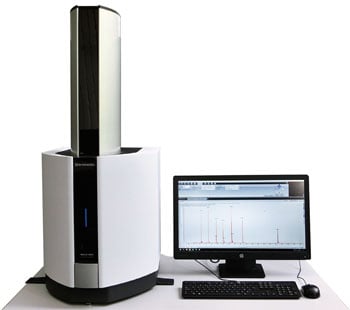
MALDI-8020


MALDI-TOF Mass Spectrometry
Matrix-assisted laser desorption/ionization (MALDI) is a rapid, simple and sensitive tool for obtaining information on the molecular weight as well as the primary structure of a peptide or protein. Among the different fragmentation methods, in-source decay (ISD) is used in ‘top-down’ proteomics to obtain the sequence of proteins. It leads to c- and z-fragment ion series via a hydrogen radical-transfer mechanism. One of the advantages of ISD over post-source decay (PSD) is that ISD is theoretically not limited by the sample mass and thus allows the sequencing of large proteins directly, without the need of an enzymatic digestion. In the pharmaceutical industry, as part of the quality control (QC) process, it is important to track any changes, either due to product formulation or degradation, as they can affect the therapeutic role, leading to a potential loss of activity or development of toxicity. An example of modifications that can occur with degradation is the oxidation of methionine residues of a peptide or protein as this amino acid is highly susceptible to oxidation. Here, were we demonstrate the capability of the MALDI-8020 benchtop linear TOF mass spectrometer to determine the methionine oxidation (Met-O) of Exendin-4 peptide through accurate intact mass analysis and top-down sequencing. This can be a potentially valuable tool in the QC environments to pinpoint undesired changes during the production process.
April 19, 2018 GMT