


Analytical Solutions for Harmful Metals in Food (AA, ICP-AES, ICP-MS, EDXRF)
Harmful metals such as arsenic (As), lead (Pb), and cadmium (Cd) must be strictly controlled down to low concentrations to ensure public health and safety. Our analytical instruments - including an atomic absorption spectrophotometer (AA), inductively coupled plasma atomic emission spectrometer (ICP-AES), and inductively coupled plasma mass spectrometer (ICP-MS) - provide high-sensitivity detection of trace elements in food. In addition, an energy dispersive X-ray fluorescence spectrometer (EDXRF) offers rapid elemental analysis without pretreatment, making it suitable for screening and emergency analyses.
Features of Various Metal Analysis Instruments
| Analysis Method | Product Name | Features | Sample |
|---|---|---|---|
| Atomic Absorption Spectrometry (AA) | Due to its simplicity and high sensitivity, AA is widely used for various standardized testing methods. The AA-7800 series offers excellent versatility and expandability. It is also designed with safety in mind, featuring standard equipment such as vibration sensors and a gas leak detection system. |
Liquid (or dissolved in solution) | |
| Inductively Coupled Plasma Atomic Emission Spectrometry (ICP-AES) | ICP-AES enables rapid, highly sensitive, and simultaneous multi-element analysis, making it widely adopted for standardized testing methods. The ICPE-9800 series supports simultaneous analysis of all elements, offers user-friendly operation through assistant functions, and features low running costs—making it suitable for a wide range of applications. |
Liquid (or dissolved in solution) | |
| Inductively Coupled Plasma Mass Spectrometry (ICP-MS) | In addition to the simultaneous multi-element capability of ICP-AES, ICP-MS provides ultra-trace sensitivity at the ppt level. The ICPMS-2040/2050 combines environmental performance with analytical power via a proprietary mini-torch system, contributing to increased efficiency by reducing measurement time without the need for special accessories. |
Liquid (or dissolved in solution) | |
| Energy Dispersive X-ray Fluorescence Spectroscopy (EDXRF) | EDXRF allows non-destructive elemental analysis of solid, powder, and liquid samples without the need for sample preparation. The ALTRACE and EDX-7200/8100 systems can detect trace heavy elements at sub-ppm levels even in light-element matrices. They also offer low operating costs and easy maintenance, making them ideal for screening hazardous metals. |
Solid, Liquid, Powder |
Cadmium Analysis in Rice Using an Atomic Absorption Spectrophotometer (AA)
Cadmium contamination in rice is a global concern. In Japan, levels are regulated under the Food Sanitation Act, while internationally, Codex Alimentarius and the EFSA set maximum residue limits to protect public health.
Using the AA-7800 atomic absorption spectrometer, cadmium levels in both brown and polished rice were quantified with high precision.
Results:
5 g samples were pretreated and measured using the furnace method. The cadmium concentrations were determined to be 0.070 ppm in brown rice and 0.118 ppm in polished rice. This demonstrates the AA-7800’s sensitivity and reliability in meeting international food safety standards.
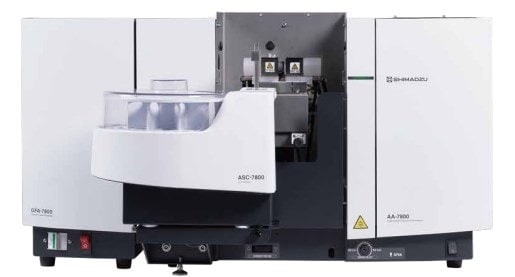
AA-7800G(Furnace Autosampler System)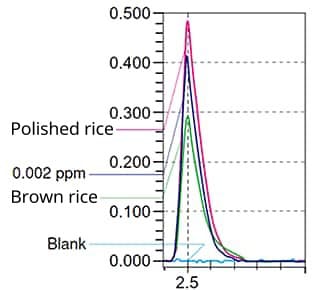
Simultaneous Multi-Element Analysis in Brown Rice Using a Multitype ICP Emission Spectrometer (ICP-AES)
Brown rice contains high levels of macro-elements like potassium (K) and phosphorus (P), but accurate monitoring also requires detection of trace elements such as cadmium.
Food safety authorities, including the EFSA, FDA, and WHO, emphasize the importance of monitoring both macro- and trace elements.
Our ICPE-9820 allows for simultaneous analysis of elements from high concentrations to trace levels through both axial (AX) and radial (RD) plasma observation. Using this system, we performed simultaneous multi-element analysis of brown rice samples.
Results:
A certified brown rice powder reference material was pretreated and analyzed.
Measured values matched certified values across all elements, ensuring compliance with international analytical performance standards.
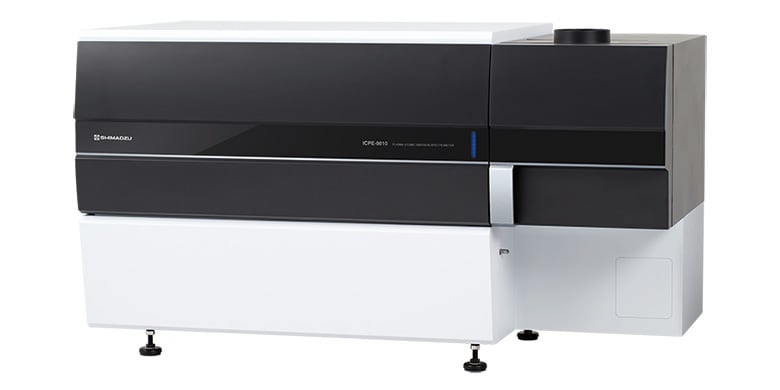
Multitype ICP Emission Spectrometers ICPE-9800 Series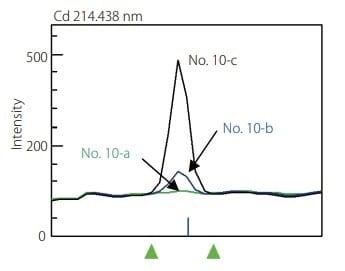
Spectral Profile of Cd
Speciation Analysis of Arsenic in Apple Juice Using an ICP Mass Spectrometer (ICP-MS)
Since the toxicity of arsenic varies depending on its chemical form (speciation), in addition to knowing the total concentration, performing speciation analysis is crucial. By combining our Nexera series liquid chromatograph with the ICPMS-2040/2050 and connecting them online (LC-ICP-MS), highly sensitive speciation analysis of arsenic is possible. Using this system, we analyzed arsenic species in apple juice.
Results:
Commercially available apple juice was diluted and analyzed using the "LC-ICP-MS Method Package for Arsenic Speciation Analysis Type 2."
Quantitative analysis and spike recovery tests were performed for arsenious acid (As(III)), arsenic acid (As(V)), monomethylarsonic acid (MMA), dimethylarsinic acid (DMA), arsenobetaine (AsB), and arsenocholine (AsC).
Good recovery rates of 101–106% were obtained.
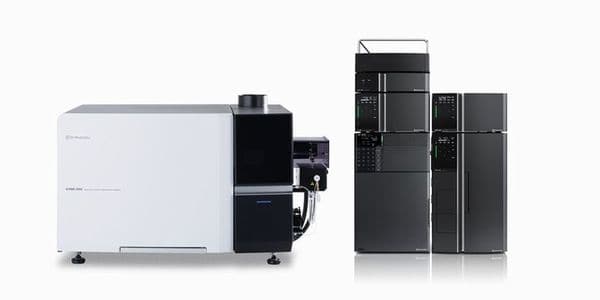
ICPMS-2040/2050 Series Nexera™ Series

Chromatograms for Each Arsenic Species Measured from 1 µg/L Solution and Actual Sample
Rapid Screening Analysis of Trace Heavy Metals in Powdered Milk Using an Energy Dispersive X-ray Fluorescence Spectrometer (EDXRF)
Heavy metal contamination in infant foods is strictly regulated worldwide, including by the Codex Alimentarius, EFSA, and FDA.
EDXRF, which can analyze powders directly, enables rapid analysis of harmful metals in powdered products like infant formula. We performed screening analysis of trace heavy metals in powdered milk using the ALTRACE, which allows for high-sensitivity analysis in one-tenth the measurement time of conventional instruments.
Results:
Commercially available powdered milk was spiked with atomic absorption standard solution, then freeze-milled. The sample was packed into a sample container with polypropylene film, lightly compressed, and then analyzed.
Quantification of arsenic (As), mercury (Hg), lead (Pb), cadmium (Cd), and tin (Sn) was performed, yielding good recovery rates of 97–102%. This supports the instrument’s suitability for global regulatory screening needs.
-
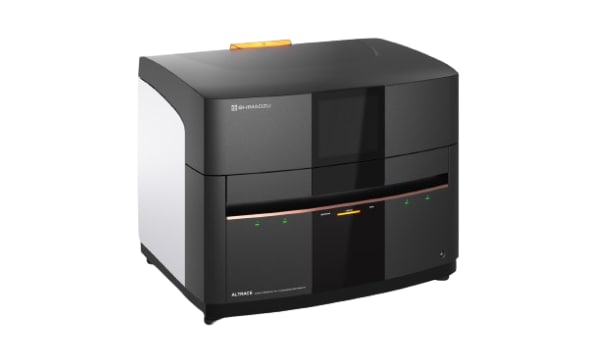
Energy Dispersive X-ray Fluorescence Spectrometer ALTRACE -
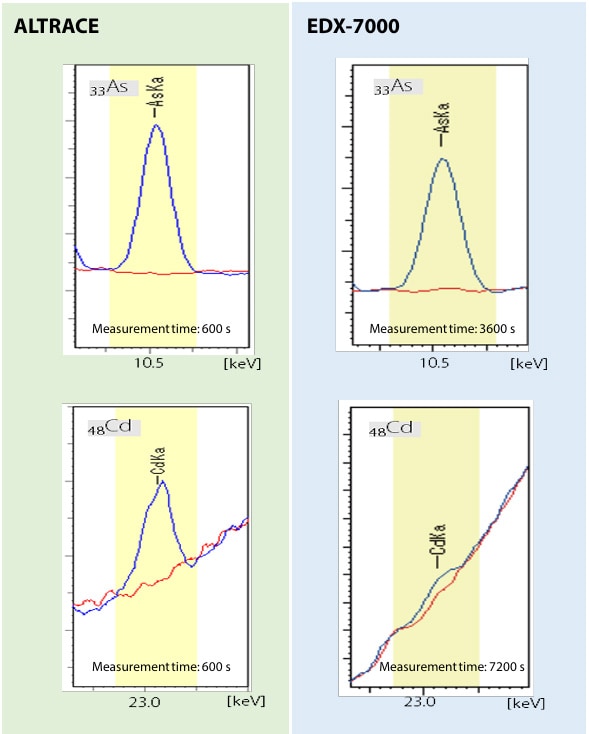
X-ray Fluorescence Spectra (Blue: As, Cd 1 ppm, Red: Blank)
Measurement time: ALTRACE (As 600 s, Cd 600 s), EDX-7000 (As 3600 s, Cd 7200 s)