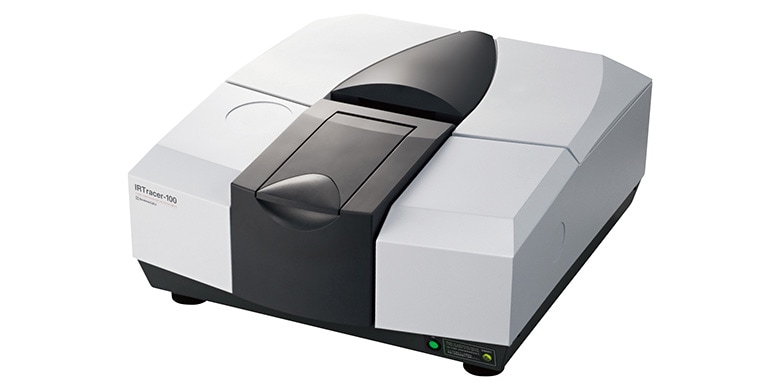
AIRsight™


Infrared Microscope

Infrared spectra of polypropylene-based (containing TALC) resin for automotive bumpers are shown to the right to compare the three detectors. The sample was placed in a diamond cell and measured in transmission method. It was measured by the T2SL and TEC MCT with a 25 × 25 μm aperture size, and by the DLATGS with a 100 × 100 μm aperture size. Liquid nitrogen was not used with the TEC MCT, and it is evident that there is a little more noise in the spectrum collected with the T2SL, which does require liquid nitrogen. A larger aperture is needed for data collection with the DLATGS detector due to its much lower sensitivity than the T2SL and TEC MCT. However, the DLATGS does have the advantage of being able to measure the sample in the low wavenumber region (down to 400 cm−1).
Choose the optimal detector for the application. The T2SL*1 detector is ideal for measuring microscopic areas 25 μm in size or smaller. A room temperature detector (DLATGS)*2, *3 is also available for acquiring data with a wavenumber range up to 400 cm−1.
| Detector | T2SL *1 | TEC MCT *2 | DLATGS *2,*3 |
|---|---|---|---|
| Standard/Optional | Standard | Optional | Optional |
| Suitable Measurement Size | 10 × 10 μm or larger | 25 × 25 μm or larger | 100 × 100 μm or larger *4 |
| Liquid Nitrogen | Required | Not required | Not required |
| Measured Wavenumber Range | 5,000–700 cm−1 | 5,000–700 cm−1 | 4,600–400 cm−1 |
*1) Liquid nitrogen is required when using the T2SL.
*2) TEC MCT and DLATGS cannot be installed at the same time.
*3) The DLATGS can measure across a wide wavenumber range. However, its sensitivity is substantially lower than the T2SL and TEC MCT.
*4) Measurable size in transmission/reflection method.
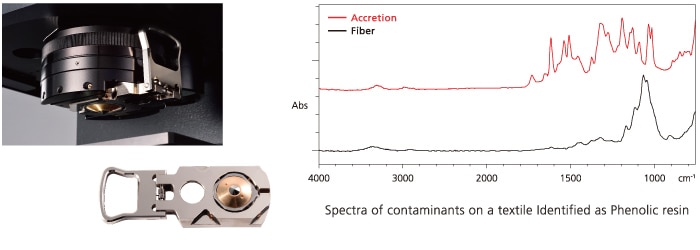
The ATR objective mirror uses a cone-type prism, with single reflection, 15× magnification, and a 45-degree incident angle. This slide-on type prism makes it easy to switch back and forth between visible observation and infrared measurement. This mirror is especially effective in analyzing samples that do not transmit or reflect infrared light easily, such as paper and plastics, or extremely thin films, such as stains.
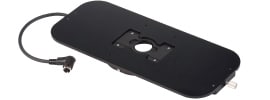
This pressure sensor prevents prism damage due to excessive pressures applied during ATR measurements using an ATR objective mirror. It can also be used to automate ATR measurement with pressure sensing.
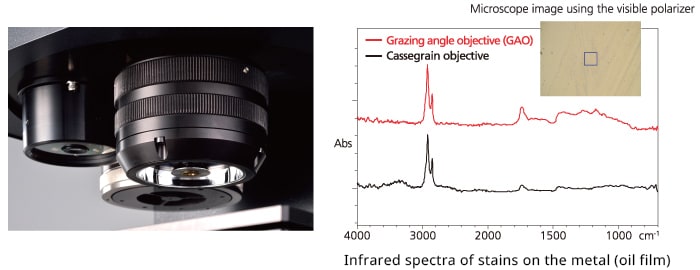
The Grazing angle objective with 80-degree incident angle is effective for the measurement of organic thin film with a nm thickness level on metal substrates. In case of failure analysis, this objective is useful for the measurement of samples on concave surfaces or stains on a metal surface.
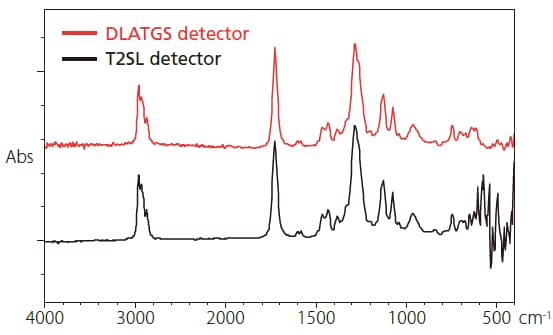
Infrared spectra of polyvinyl chloride (PVC)
By adding this DLATGS detector to an AIMsight infrared microscope, infrared spectra can be obtained without liquid nitrogen. It is also possible to switch back and forth between the T2SL and DLATGS detectors as needed. The DLATGS detector offers a wider wavenumber range (up to 400 cm-1) than the T2SL detector, but with lower sensitivity. Therefore, the T2Sl detector is used to measure micro samples less than 100 µm.

Infrared spectra of a single fiber
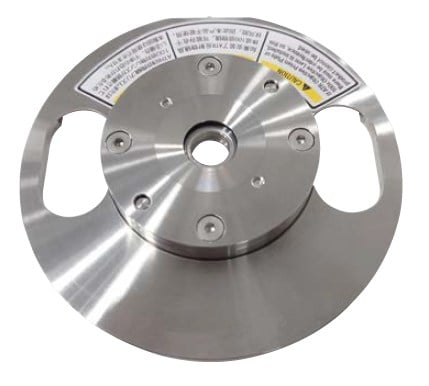
This diamond compression cell is used to compress micro samples very thin for direct measurement under the microscope. It can be used for samples such as plastics and fibers. This CII cell features a large thin window plate made of artificial diamond (1.6 mm diameter).
Sealed cell excluding window plate: P/N 206-37600-41
This cell is designed to contain samples which need to be kept in an inert atmosphere throughout the process of sample preparation and measurement. By selecting the appropriate window plates for the applicable spectroscopy method, this cell can maintain samples in a sealed condition during infrared analysis.
For infrared transmission/reflectance mode:
CaF2 window plate (assembly): P/N 206-37617-41
For infrared reflectance mode:
CaF2 window plate (single): P/N 206-36981-01
Maximum sample size:
Infrared transmission mode: 13.5 mm in diameter, 0.5 mm in thickness
Infrared reflectance mode: 15 mm in diameter, 0.5 mm in thickness
This accessory is useful for researching the orientation characteristics of samples, or increasing sensitivity with Grazing Angle Objective measurements. It can be used by inserting it into the microscope from the side.
This accessory is useful for visible observation of samples that are normally difficult to observe using visible light. Using the properties of polarized light can make samples easier to see.

For 13 mm dia.
The PF holder fastens the Membrane Filter (PTFE or stainless steel (SUS)) used in microplastics analysis by gripping it. This prevents the Membrane Filter from sagging during drying, which keeps the surface flat and enables more accurate measurements.
For 13 mm dia. (2pc) : P/N 206-36610-41
For 25 mm dia. (2pc) : P/N 206-36610-42
This unique library was created by Shimadzu especially for analyzing contaminants in tap water and food products. The library includes information about samples collected as contaminants and service parts commercially marketed for tap water applications. It also includes a collection of X-ray fluorescence profiles (PDF files). Consequently, it can significantly improve the qualitative accuracy of the objects. Unlike previous libraries, this is a mixture library that covers the extensive knowledge and experience necessary for qualitative analysis.
This unique library includes information about plastics that have been damaged due to oxidation by heating. The libraries are especially useful for analyzing damaged objects, which are common.
*5) Shimadzu created the library using spectra obtained by the Hamamatsu Technical Support Center, Industrial Research Institute of Shizuoka Prefecture.
This unique library includes information about plastics that have been damaged due to oxidation by Ultraviolet rays. The libraries are especially useful for analyzing damaged contaminant substances, which are common.
*6) Plastics that were damaged for 10 years worth by using an Iwasaki Electric super accelerated weathering tester were measured and compiled as a library by Shimadzu Corporation.

Activate John Wiley & Sons, Inc. KnowItAll from a button in the LabSolutions IR software to automatically transfer the active spectrum. With KnowItAll, you can perform searches using a rich library, analysis of constituent components and constituent ratios by mixture analysis, and functional group analysis by searching for functional groups of specified peaks.

Line and area mapping modes are available for infrared measurements. In addition to typical transmission and reflection mapping modes, an ATR microscope mapping measurement can be selected (which requires an optional ATR objective mirror and pressure sensor).
Using the high-speed mapping program, measurements can be performed with the specified number of accumulations at points determined to contain samples based on the spectra*7. Points determined to contain no samples are measured at a single accumulation, which allows faster performance while maintaining the spectra's quality. Using the mapping measurement results, a chemical image can be created based on peak heights/areas, multivariate analysis (PCA/MCR), or similarity to a target spectrum, allowing visualization of the distribution of components that otherwise cannot be confirmed visually.
*7) The high-speed mapping function is only available in the area mapping mode for infrared (transmission/reflection) measurements.
By adding a particle analysis program to AMsolution, the chemical images obtained from mapping measurements*8 can be used to calculate individual particle qualities, as well as the major axis, minor axis, mass*9, and volume*9. In addition, this statistical information can be easily displayed. The program can be used from the [Particle Analysis] tab page, thereby maintaining the same operational setup as the AMsolution analysis software. The particle analysis program can be used for a variety of analyses, including the analysis of microplastics and contaminant analysis.
*8) The optional High-Speed Mapping Program is separately required.
*9) Mass and volume are calculated based on the theoretical formula (Formula (1) [log10(M)=b·log10(S)+a]) used in the article referenced below. This theoretical formula applies only to microplastics. Shimadzu cannot guarantee the validity of the mass results.
Tomoya Kataoka, Yota Iga, Rifqi Ahmad Baihaqi, et al. Geometric relationship between the projected surface area and mass of a plastic particle. Water Research. 2024;261:122061.